Blog
Discover how much it costs to build a SaaS platform, from a focused MVP to a scalable enterprise product, including development and operating expenses.
How Much Does It Cost to Build a SaaS Platform?
The cost to build a SaaS platform in 2026 typically ranges from $40,000 for a focused MVP to more than $500,000 for a complex enterprise product.
A small Micro-SaaS product with one core workflow may cost less. A platform requiring multi-tenant architecture, advanced permissions, usage-based billing, multiple integrations, AI functionality, or regulatory compliance can exceed $1 million.
For US founders and product teams, practical planning ranges are:
| SaaS product stage | Estimated development cost |
|---|---|
| Prototype or proof of concept | $10,000–$30,000 |
| Micro-SaaS product | $25,000–$60,000 |
| Lean SaaS MVP | $40,000–$100,000 |
| Production-ready SaaS version one | $80,000–$250,000 |
| Growth-stage B2B SaaS platform | $150,000–$400,000 |
| Enterprise SaaS platform | $300,000–$1,000,000+ |
These figures are planning ranges rather than fixed quotes. Current industry estimates also vary widely. One recent 2026 SaaS development analysis places SaaS products between $50,000 and $500,000, while Clutch reports that the average reviewed software development project costs approximately $132,000.
The final SaaS development cost depends on five connected factors:
- Product scope and feature complexity
- Multi-tenant architecture and scalability
- Billing, integrations, data, and AI
- Development team and delivery model
- Security, operations, and post-launch development
Each factor affects the next. A larger product scope requires a more sophisticated architecture, more integrations, a larger team, deeper testing, and higher operating costs.
Quick Answer: What Should a SaaS Founder Budget?
A bootstrapped founder building a focused web-based SaaS MVP should generally budget approximately $40,000–$100,000.
A funded startup developing a production-ready B2B SaaS product with team accounts, subscription billing, role-based access, an admin panel, reporting, and several integrations should expect approximately $80,000–$250,000.
A growth-stage company building enterprise functionality—including SSO, audit logs, advanced analytics, APIs, compliance controls, and high availability—may need $250,000–$1 million or more.
A realistic budget must also include expenses after launch. Development is only the first part of building a SaaS business.
Why Does SaaS Cost More Than a Standard Web Application?
A regular web application may support users completing a particular task. A SaaS platform must also operate as a repeatable commercial product for many customers.
That usually requires:
- Customer registration and onboarding.
- Secure tenant separation.
- Multiple users within each customer account.
- Roles and permissions.
- Subscription and usage billing.
- Trials, upgrades, downgrades, and cancellations.
- Feature access based on plans.
- Administrator and support tools.
- Usage analytics.
- Notifications.
- Reliable deployment and monitoring.
- Data export and account deletion.
- A scalable infrastructure.
- Continuous security and product updates.
A functional application becomes a SaaS business only when customers can discover, purchase, use, manage, and renew the product reliably.
SaaS Development Cost by Product Stage
Prototype: $10,000–$30,000
A prototype helps founders validate a workflow, interface, or technical concept.
It may include:
- A clickable UX prototype.
- A limited frontend demonstration.
- Sample data.
- A proof-of-concept integration.
- An experimental AI workflow.
- No complete multi-tenant or security model.
A prototype is useful for investor discussions, user interviews, or technical validation. It is not necessarily safe or reliable enough for paying customers.
Micro-SaaS: $25,000–$60,000
A Micro-SaaS product usually solves one specific problem for a narrow audience.
Examples include:
- A reporting extension.
- A scheduling tool.
- A document automation product.
- A specialist analytics dashboard.
- A small marketing automation platform.
- An integration between two popular systems.
A Micro-SaaS product may have one or two user roles, simple billing, a limited administration area, and few integrations.
The cost rises when “small” refers only to the target market while the technical requirements remain complex.
Lean SaaS MVP: $40,000–$100,000
A lean SaaS MVP should be usable by real customers and capable of processing real payments.
A typical scope includes:
- Secure authentication.
- One primary customer workflow.
- Basic multi-tenancy.
- One or two user roles.
- Subscription billing.
- Customer dashboard.
- Basic admin panel.
- Transactional email.
- Analytics and monitoring.
- Responsive web experience.
- Cloud deployment.
- Launch support.
The objective is to test whether customers will adopt and pay for the core product—not to build every item on the long-term roadmap.
Production SaaS version one: $80,000–$250,000
A production-ready SaaS platform may include:
- Organization and workspace accounts.
- Advanced role-based access.
- Multiple subscription tiers.
- Free trials and coupons.
- Plan-based feature limits.
- Customer onboarding.
- Administrator and support dashboards.
- Reporting and exports.
- Third-party integrations.
- APIs and webhooks.
- Background jobs.
- Automated notifications.
- Audit logging.
- CI/CD pipelines.
- Monitoring and backup processes.
This range is common for startups that have validated the idea and are ready to build a defensible product for consistent customer acquisition.
Growth-stage SaaS platform: $150,000–$400,000
A growth-stage platform often adds:
- Public APIs.
- More advanced analytics.
- Team collaboration.
- SSO or SAML.
- Custom customer roles.
- Usage-based pricing.
- Automated account provisioning.
- Data import and migration.
- White-label features.
- Mobile applications.
- Advanced integrations.
- Customer-level performance monitoring.
- Compliance preparation.
At this stage, the engineering team must balance new feature development with performance, reliability, security, and reducing technical debt.
Enterprise SaaS: $300,000–$1,000,000+
Enterprise SaaS products may require:
- Complex tenant-isolation models.
- Dedicated customer environments.
- Advanced identity management.
- Enterprise SSO.
- Detailed audit trails.
- High availability.
- Multi-region infrastructure.
- Data residency.
- Custom SLAs.
- Large-volume data processing.
- Legacy enterprise integrations.
- Formal security reviews.
- Regulatory controls.
- Advanced reporting and BI.
- Implementation and customer training.
Enterprise customer requests can create long-term engineering obligations, so each major customization should be evaluated against its revenue potential and effect on the shared product.
1. Product Scope Establishes the Initial Budget
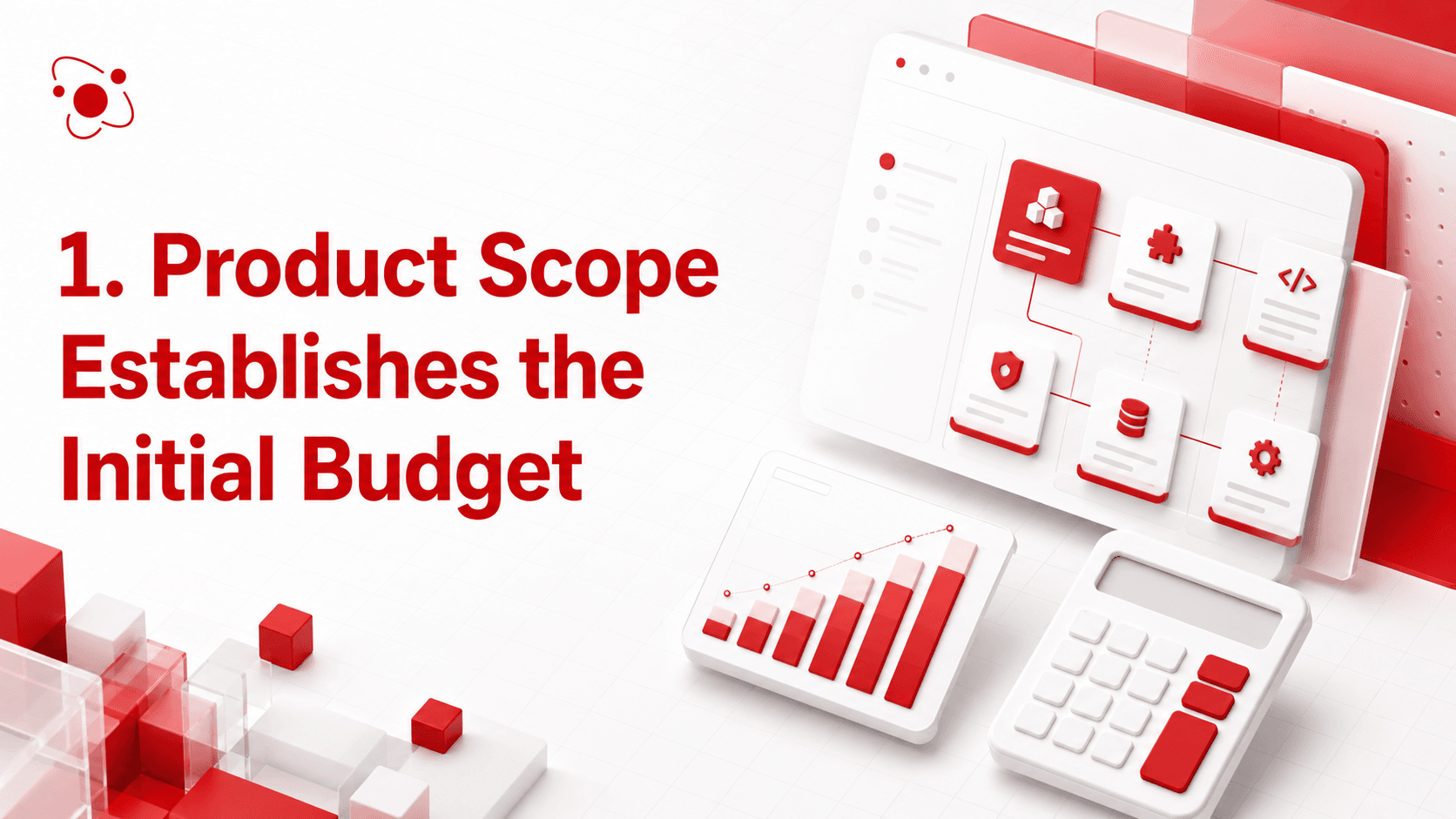
The first driver of the cost to build a SaaS platform is the size and complexity of the product scope.
A feature that sounds simple in a pitch deck can contain many separate requirements.
For example, “subscription management” may require:
- Multiple products and prices.
- Monthly and annual plans.
- Trials.
- Discount codes.
- Tax handling.
- Plan upgrades.
- Downgrades.
- Proration.
- Failed-payment recovery.
- Invoice generation.
- Refunds.
- Cancellations.
- Feature restrictions.
- Usage metering.
- Customer billing portals.
Each business rule must be designed, developed, tested, monitored, and maintained.
Features that significantly increase SaaS costs
- Real-time collaboration.
- AI or machine learning.
- Video or audio processing.
- Complex reporting.
- Data visualization.
- Native mobile applications.
- Offline functionality.
- Marketplace functionality.
- Geographic tracking.
- Custom workflow builders.
- Large-scale data imports.
- Multiple languages.
- Advanced search.
- Industry-specific compliance.
- Numerous external integrations.
Start with the customer outcome
A founder can control scope by defining one result the first version must deliver.
For example:
- Help agencies generate a client report in five minutes.
- Allow clinics to manage one type of appointment.
- Automate one repetitive accounting workflow.
- Let logistics teams track a particular type of shipment.
- Help sales teams generate accurate proposals.
Once the main outcome is clear, every requested feature can be tested against it.
If a feature does not help validate the central value proposition, it may belong in a later release.
After defining what the product does, the team must decide how multiple customers will use it safely and efficiently.
2. Multi-Tenant Architecture and Scalability Affect the Foundation
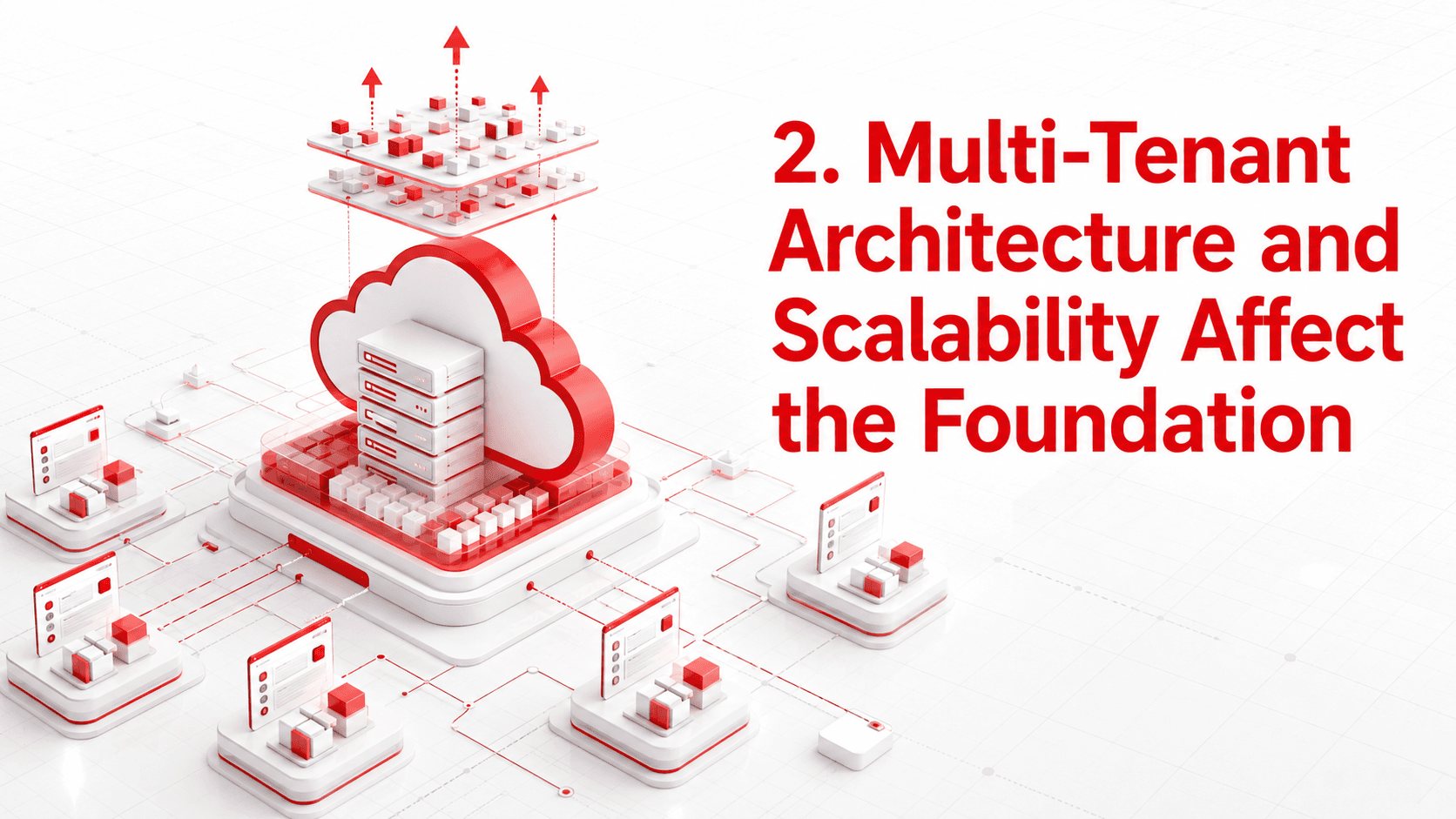
Multi-tenancy allows one SaaS product to serve many customer organizations while maintaining appropriate separation of users, data, settings, and billing.
A tenant may represent:
- A company.
- A team.
- A department.
- A franchise.
- A client workspace.
- An individual paying customer.
Multi-tenancy affects the database, authentication, permissions, infrastructure, logging, analytics, and support tools.
Common tenant-isolation models
The AWS SaaS Lens describes three broad architectural models:
- Pool: Tenants share infrastructure and resources.
- Silo: Each tenant receives dedicated resources.
- Bridge: Some components are shared while others are isolated.
A pooled model can provide greater cost efficiency but requires strong controls to prevent cross-tenant access.
A silo model offers stronger infrastructure separation but may be more expensive and operationally complex.
A bridge model balances shared and dedicated resources based on regulatory, performance, and customer requirements.
Tenant identity and permissions
Every user request must be associated with the correct customer account.
AWS highlights tenant context as a fundamental part of identity and access management for SaaS.
The system must determine:
- Which organization the user belongs to.
- Which workspace is currently active.
- What the user can view.
- Which actions the user can perform.
- Which data the user can export.
- Whether the user can invite or remove others.
- Which plan and feature limits apply.
Incorrect tenant isolation is not a minor bug. It can expose one customer’s data to another.
Avoid premature overengineering
An MVP does not automatically need:
- Dozens of microservices.
- Kubernetes.
- Multiple cloud regions.
- Event-driven architecture for every action.
- Dedicated infrastructure for every customer.
- Custom-built authentication.
- A proprietary billing engine.
A modular monolith using managed services can often support an early SaaS product while remaining maintainable.
The right architecture should support expected growth without financing infrastructure for a scale the product has not yet reached.
Once the foundation is established, the product needs commercial capabilities: billing, integrations, data management, and potentially AI.
3. Billing, Integrations, Data, and AI Increase Complexity
Subscription billing
Billing is part of the product, not simply a payment page.
A SaaS billing system may need to support:
- Flat monthly subscriptions.
- Per-user pricing.
- Tiered plans.
- Usage-based pricing.
- Hybrid subscription and usage models.
- Annual contracts.
- Free and paid trials.
- Coupons.
- Proration.
- Failed-payment recovery.
- Tax calculation.
- Invoices.
- Customer billing portals.
- Revenue reporting.
- Feature access based on plan.
Stripe Billing supports multiple subscription and usage-pricing models, which can reduce the need to build billing infrastructure from scratch.
However, implementation work is still required to connect billing events to customer accounts, permissions, usage, invoices, failed payments, and product access.
Stripe’s current Billing pricing includes a pay-as-you-go option based on billing volume. Founders should model payment processing and billing-platform fees separately from development costs.
Third-party integrations
SaaS products commonly integrate with:
- CRM platforms.
- Accounting software.
- Email providers.
- Identity providers.
- Storage services.
- Analytics platforms.
- Customer support tools.
- Marketing automation.
- Communication tools.
- AI providers.
- Other SaaS products.
An integration requires more than sending one API request.
The development team must handle:
- Authentication.
- Permission scopes.
- Field mapping.
- API limits.
- Webhooks.
- Duplicate events.
- Failed requests.
- Retries.
- Data conflicts.
- API version changes.
- Monitoring.
- Customer configuration.
A well-documented modern API may take several days to integrate. A complex bidirectional or poorly documented integration may require several weeks.
Data import and export
B2B customers may expect to import existing data when they start using the product.
That can require:
- CSV templates.
- Field mapping.
- Validation.
- Duplicate detection.
- Import progress.
- Error reports.
- Rollback procedures.
- Migration services.
Customers may also require full data export or deletion when they leave.
These workflows are often underestimated during MVP planning.
AI functionality
AI features may include:
- Content generation.
- Document extraction.
- Classification.
- Recommendations.
- Semantic search.
- Forecasting.
- Conversational assistants.
- Workflow automation.
- Image or audio processing.
Using an existing model API can reduce initial research and training costs, but the product still requires:
- Prompt and workflow design.
- Data preparation.
- Retrieval systems.
- Output validation.
- Usage controls.
- Error handling.
- Privacy safeguards.
- Cost monitoring.
- Evaluation and testing.
- Human-review processes.
AI can accelerate development work, but adding AI to the product does not automatically make the platform cheaper.
The product scope and architecture determine what must be built. The team model determines what that work will cost.
4. Development Team and Delivery Model Affect the Price
A SaaS development team may include:
- Product manager.
- Business analyst.
- UX/UI designer.
- Software architect.
- Frontend engineer.
- Backend engineer.
- QA engineer.
- DevOps engineer.
- Security specialist.
- Data or AI engineer.
A lean MVP team may combine some roles. A complex platform requires more specialization.
Typical hourly ranges
| Delivery model | Approximate hourly range |
|---|---|
| US independent specialist | $75–$200 |
| Small US development studio | $100–$175 |
| Established US product agency | $125–$250+ |
| US-led distributed team | $60–$150 |
| Nearshore team | $50–$120 |
| Offshore team | $25–$80 |
Location alone does not determine quality. The total result depends on experience, architecture, communication, product understanding, QA, and the amount of rework required.
Fixed-price project
Best when:
- The MVP scope is clearly defined.
- The timeline is limited.
- Acceptance criteria are documented.
- Budget predictability is important.
The quote may include a risk buffer, and significant changes usually require change requests.
Time and materials
Best when:
- The product is evolving.
- Priorities may change.
- Founders are testing assumptions.
- The team is managed through regular sprints.
This model offers flexibility but requires active product ownership and budget controls.
Dedicated product team
Best when:
- The SaaS product needs continuous development.
- The roadmap extends beyond the initial launch.
- The startup has product-market evidence.
- Consistent technical knowledge is important.
A dedicated team creates predictable capacity but is only economical when there is enough prioritized work.
In-house product team
An in-house team provides direct control but requires salaries, benefits, recruitment, equipment, management, and retention.
Most SaaS products need several roles. Hiring one full-stack developer does not replace UX, product management, QA, DevOps, security, or support.
Many early-stage startups use an experienced development partner to reach launch, then add internal technical leadership and engineers as revenue and funding grow.
Once the product is developed, it must be operated securely and reliably for every customer.
5. Security, Operations, and Post-Launch Development Define the Real Cost
Security is particularly important in SaaS because many customers rely on the same product and infrastructure.
The NIST Secure Software Development Framework recommends integrating security practices throughout the software development lifecycle.
A production SaaS security scope may include:
- Secure authentication.
- Role-based authorization.
- Tenant isolation.
- Encryption.
- Audit logging.
- Secret management.
- Dependency scanning.
- Backup and recovery.
- Rate limiting.
- Vulnerability testing.
- Incident-response procedures.
- Security monitoring.
- Controlled production access.
Compliance and enterprise readiness
Depending on the product and customers, costs may increase for:
- SOC 2 preparation.
- HIPAA requirements.
- PCI DSS.
- State privacy laws.
- GDPR.
- Accessibility.
- Data residency.
- Enterprise vendor assessments.
- Penetration testing.
- Cybersecurity insurance requirements.
Compliance is not a feature that can be added at the end. It affects architecture, vendors, access controls, documentation, monitoring, and internal company processes.
Your legal and compliance specialists should determine which requirements apply.
Quality assurance
A SaaS platform should be tested for:
- Customer onboarding.
- Account isolation.
- Roles and permissions.
- Subscription changes.
- Failed payments.
- Plan restrictions.
- Integrations.
- Data imports.
- Browser and device compatibility.
- Performance.
- Security.
- Backup and restoration.
- Deployment and rollback.
A bug in one customer’s dashboard is inconvenient. A bug that exposes another tenant’s data or miscalculates billing can threaten the company.
What Does It Cost to Operate a SaaS Platform?
After launch, SaaS operating expenses may include:
- Cloud hosting.
- Database and storage.
- Content delivery.
- Email and SMS.
- Billing and payment fees.
- Monitoring.
- Error tracking.
- Analytics.
- Customer support software.
- Security tools.
- Backups.
- AI API usage.
- Maintenance.
- New feature development.
Estimated monthly operating costs
| SaaS stage | Approximate monthly operating cost |
|---|---|
| Prototype or private beta | $100–$1,000 |
| Early SaaS MVP | $500–$3,000 |
| Early revenue stage | $2,000–$10,000 |
| Growing SaaS product | $5,000–$30,000+ |
| Enterprise SaaS | $20,000–$150,000+ |
These figures can include infrastructure, third-party services, monitoring, maintenance, and support, but not necessarily customer acquisition or a full-time engineering team.
AI processing, video, real-time data, large files, heavy analytics, and dedicated customer infrastructure can increase operating costs quickly.
Maintenance and product development
A useful initial planning rule is to reserve approximately 10%–25% of the original development cost per year for maintenance, security updates, bug fixes, and modest improvements.
A SaaS company pursuing growth will usually invest more because the product must continuously respond to:
- Customer feedback.
- Competitor activity.
- Security updates.
- Integration changes.
- New pricing models.
- Performance requirements.
- Enterprise requests.
- Regulatory changes.
Maintenance keeps the system operational. Product development keeps the company competitive.
Example SaaS Development Budgets
Example 1: Lean B2B SaaS MVP
Scope:
- One core workflow.
- Company accounts.
- Two user roles.
- Basic subscription billing.
- Customer dashboard.
- Admin panel.
- Email notifications.
- One integration.
- Cloud deployment.
| Phase | Estimated cost |
|---|---|
| Discovery and planning | $5,000–$12,000 |
| UX/UI design | $7,000–$15,000 |
| Frontend development | $15,000–$30,000 |
| Backend and multi-tenancy | $20,000–$40,000 |
| Billing and integration | $8,000–$18,000 |
| QA, security, and launch | $8,000–$20,000 |
| Estimated total | $63,000–$135,000 |
Example 2: Production SaaS Version One
Scope:
- Multi-tenant organizations.
- Multiple roles and permissions.
- Three subscription plans.
- Trials and plan changes.
- Advanced onboarding.
- Reports and exports.
- Admin and support tools.
- Three integrations.
- API and webhooks.
- Monitoring and backups.
| Phase | Estimated cost |
|---|---|
| Product discovery and architecture | $10,000–$25,000 |
| UX/UI and design system | $15,000–$30,000 |
| Core product development | $60,000–$140,000 |
| Billing and integrations | $20,000–$50,000 |
| QA, security, and performance | $20,000–$45,000 |
| DevOps and deployment | $8,000–$20,000 |
| Estimated total | $133,000–$310,000 |
Example 3: Enterprise SaaS Platform
Scope:
- Advanced multi-tenancy.
- Enterprise SSO.
- Detailed audit logs.
- Customer-specific permissions.
- Public APIs.
- Legacy integrations.
- Compliance controls.
- Advanced analytics.
- High availability.
- Migration and customer training.
Estimated development cost: $300,000–$1,000,000+
Hidden Costs Outside the Development Quote
Before accepting a proposal, determine whether it includes:
- Product discovery.
- UX/UI design.
- Technical architecture.
- Project management.
- Test automation.
- Data migration.
- Cloud setup.
- Monitoring and backups.
- Security assessments.
- Compliance preparation.
- Documentation.
- Launch support.
- Post-launch warranty.
- Source-code transfer.
- Third-party subscriptions.
- Usage-based API fees.
- Taxes and payment fees.
Also remember that development costs do not normally include:
- Customer acquisition.
- Sales staff.
- Paid advertising.
- Content marketing.
- Legal documents.
- Accounting.
- Customer success.
- Cybersecurity insurance.
- External audits.
A successful SaaS business needs a product budget and a go-to-market budget.
How to Reduce the Cost of Building a SaaS Platform
1. Validate the problem before developing the platform
Interview target customers and confirm that the problem is urgent enough to justify payment.
A strong technical product cannot compensate for weak demand.
2. Build one complete workflow
A complete solution to one important problem is more useful than ten unfinished features.
The MVP should help a customer reach a clear result from beginning to end.
3. Delay enterprise features
SSO, complex audit logs, white labeling, custom infrastructure, and advanced permissions may be valuable later.
Do not add them to the MVP unless they are essential to winning the first customers.
4. Use managed services selectively
Authentication, billing, email, storage, analytics, and monitoring can often be handled by proven platforms.
Evaluate vendor costs and portability, but avoid rebuilding mature infrastructure without a strong business reason.
5. Prototype complex workflows first
Test the interface with target users before engineering begins. Design changes are less expensive than rebuilding developed functionality.
6. Launch in phases
A practical SaaS roadmap is:
- Discovery and prototype.
- Focused MVP.
- Private beta.
- Paid launch.
- Product improvement.
- Scale and enterprise readiness.
7. Assign one product owner
One accountable decision-maker should control priorities, answer questions, and approve work.
Conflicting stakeholder feedback increases time and cost.
8. Measure unit economics early
Track:
- Customer acquisition cost.
- Monthly recurring revenue.
- Gross margin.
- Churn.
- Expansion revenue.
- Infrastructure cost per customer.
- Support cost per customer.
Engineering decisions should support a viable SaaS business, not only a functional product.
How Neutrons Builds SaaS Platforms
Neutrons designs and develops scalable SaaS products for founders and established businesses.
Our SaaS platform development service covers:
- SaaS discovery and product strategy.
- MVP development.
- Multi-tenant architecture.
- Authentication and role-based access.
- Subscription and usage billing.
- APIs and integrations.
- Customer and admin dashboards.
- Cloud infrastructure and DevOps.
- Monitoring and security updates.
- Continuous product development.
Projects are delivered through four clear stages:
- Discovery and scoping.
- UX and technical architecture.
- Development and integration.
- Launch, monitoring, and scaling.
Clients receive ownership of the source code, design files, and infrastructure created for their product.
You can also explore the Neutrons portfolio and case studies.
Questions to Ask a SaaS Development Partner
Before accepting a quote, ask:
- What is included in the MVP?
- Which features are excluded?
- How will tenants and data be isolated?
- How will subscriptions and plan limits work?
- Who owns the source code?
- Will we have access to the repository and cloud accounts?
- How will the product be tested?
- What third-party costs should we expect?
- How are scope changes handled?
- What happens after launch?
- Can the architecture scale without a rewrite?
- How are backups and incidents handled?
- Can another team maintain the software?
- What assumptions could change the estimate?
- What is the expected monthly operating cost?
A credible development partner should explain these decisions in business language, not hide them behind technical terminology.
Frequently Asked Questions
How much does it cost to build a SaaS platform?
A focused SaaS MVP typically costs $40,000–$100,000. A production-ready version one may cost $80,000–$250,000, while enterprise platforms can range from $300,000 to more than $1 million.
How much does a SaaS MVP cost?
A lean SaaS MVP for real customers generally costs $40,000–$100,000 in the US market. Products with advanced multi-tenancy, AI, complex billing, or multiple integrations may cost more.
How long does it take to build a SaaS platform?
A focused MVP may take 8–16 weeks. A full version one can take four to nine months, while enterprise platforms may require a year or longer.
What should a SaaS MVP include?
It should include one valuable customer workflow, authentication, basic tenant separation, billing, a customer dashboard, administration tools, monitoring, security, and a production deployment.
Does a SaaS MVP need multi-tenant architecture?
Not every prototype needs it, but a product intended to serve multiple customer organizations should plan tenant identity and data isolation early.
How much does SaaS hosting cost?
An early SaaS product may spend $100–$3,000 per month on infrastructure and services. Growing or data-intensive products can spend tens of thousands per month.
Is no-code suitable for a SaaS MVP?
No-code can be useful for prototypes and straightforward workflows. It may become limiting when the product requires complex logic, advanced permissions, performance, deep integrations, or strict security requirements.
Can AI reduce SaaS development costs?
AI-assisted development may improve productivity, but it does not eliminate architecture, UX, code review, testing, security, and product management. AI features can also create additional usage and evaluation expenses.
Should founders use a fixed-price or hourly contract?
Fixed pricing works for a clearly defined MVP. Time and materials is more appropriate when product requirements are expected to evolve.
Who owns the SaaS source code?
Ownership depends on the contract. Neutrons transfers ownership of the source code and project assets developed for the client.
How much should be budgeted after launch?
Reserve at least 10%–25% of the original build cost annually for maintenance and basic improvements, plus infrastructure, third-party services, support, and customer acquisition.
Get an Accurate SaaS Development Estimate
The cost to build a SaaS platform depends on the scope, architecture, billing model, integrations, team, security requirements, and expected scale.
The best estimate is not the lowest number. It is the proposal that clearly defines what will be built, how customer data will be protected, how the product will scale, and what costs continue after launch.
If you are planning a Micro-SaaS, B2B product, subscription platform, or enterprise SaaS solution, contact Neutrons for a free consultation and transparent project estimate.