Blog
A practical 2026 pricing guide for custom software in the USA, covering MVPs, SaaS products, internal systems, hourly rates, maintenance, and budgeting.
How Much Does Custom Software Development Cost in the USA in 2026?
The custom software development cost in the USA can range from approximately $25,000 for a focused internal tool to more than $500,000 for a complex enterprise platform. Large, regulated, data-intensive, or AI-powered systems may exceed $1 million.
That range is wide because “custom software” can mean anything from a simple workflow dashboard to a multi-tenant SaaS platform serving thousands of customers.
For most US startups and mid-sized businesses, realistic planning ranges in 2026 are:
| Project type | Estimated 2026 cost |
|---|---|
| Prototype or proof of concept | $10,000–$30,000 |
| Focused internal business tool | $25,000–$75,000 |
| Production-ready MVP | $40,000–$120,000 |
| Custom CRM or operations platform | $75,000–$200,000 |
| SaaS product version one | $80,000–$250,000 |
| Multi-system business platform | $150,000–$500,000 |
| Complex enterprise software | $250,000–$1,000,000+ |
These are planning ranges, not fixed quotes. The final price depends on scope, complexity, integrations, team structure, security requirements, and the amount of work required after launch.
Current Clutch software development pricing data reports an average reviewed software project cost of approximately $132,000, while individual projects vary significantly. GoodFirms’ 2026 custom software cost survey found that most surveyed small-to-medium projects cost between $30,000 and $100,000, while larger projects often exceed $200,000.
To estimate your own project accurately, evaluate five connected cost drivers:
- Product scope and functional complexity
- Team structure, location, and engagement model
- UX, architecture, integrations, and data
- Security, compliance, testing, and deployment
- Maintenance, infrastructure, and future development
Each decision changes the next one. A larger scope requires a larger team, more complex architecture, additional testing, and higher post-launch costs.
Quick Answer: What Should You Budget?
If you are an early-stage founder validating an idea, budget approximately $40,000–$100,000 for a focused, production-ready MVP.
If you are building a SaaS product with subscriptions, multiple user roles, administration tools, reporting, and third-party integrations, a more realistic budget is $80,000–$250,000.
If you are replacing spreadsheets or disconnected business systems with a custom CRM, ERP, or operations platform, plan for $75,000–$300,000, depending on the number of departments, workflows, integrations, and migration requirements.
Enterprise platforms involving sensitive data, advanced permissions, audit logs, legacy integrations, complex reporting, or regulatory requirements can cost $250,000 to $1 million or more.
The most reliable way to reduce uncertainty is to start with a paid or clearly defined discovery phase, produce a prioritized scope, and price the product in stages.
Custom Software Cost by Project Type
Prototype or proof of concept: $10,000–$30,000
A prototype demonstrates how an idea or core interaction could work. It may include:
- A clickable interface.
- Limited frontend functionality.
- A technical proof of concept.
- One experimental integration.
- Sample rather than production data.
- No complete security or scalability architecture.
A prototype is useful for stakeholder alignment, technical validation, or investor conversations. It is usually not ready for production users.
Focused internal tool: $25,000–$75,000
A focused internal tool may replace spreadsheets or automate one defined workflow.
Examples include:
- An approval management system.
- A sales quotation tool.
- An internal reporting dashboard.
- A customer onboarding workflow.
- A scheduling application.
- A lightweight inventory tool.
- A document or case management portal.
Costs increase when the system requires multiple user roles, historical data migration, complex calculations, or integrations with existing platforms.
Production-ready MVP: $40,000–$120,000
A Minimum Viable Product should be usable by real customers, not merely demonstrate an idea.
A production MVP commonly includes:
- User registration and authentication.
- One core customer journey.
- A responsive web interface.
- Admin management tools.
- Basic notifications.
- Analytics and error tracking.
- Security controls.
- Cloud deployment.
- Quality assurance and launch support.
The goal is to validate the main business assumption without financing every future feature.
An MVP becomes more expensive when founders include advanced reporting, native mobile applications, multiple subscription tiers, real-time collaboration, AI features, or many integrations in version one.
SaaS platform: $80,000–$250,000
A scalable custom SaaS platform usually requires more than a standard web application.
The scope may include:
- Multi-tenant architecture.
- Account and workspace separation.
- Role-based access.
- Subscription billing.
- Trials, upgrades, and cancellations.
- Customer and administrator dashboards.
- Usage tracking.
- Email and in-app notifications.
- Reporting and analytics.
- APIs and webhooks.
- Monitoring and support tools.
- Secure cloud infrastructure.
Building these foundations correctly costs more initially but reduces the risk of an expensive architectural rewrite as the product grows.
Custom CRM or ERP system: $75,000–$300,000
A custom CRM or ERP platform may connect sales, customers, inventory, finance, operations, employees, and reporting.
The price depends heavily on:
- The number of business departments.
- User roles and approval levels.
- Workflow complexity.
- Data migration.
- Third-party integrations.
- Reporting requirements.
- Number of locations.
- Mobile access.
- Audit and compliance requirements.
A phased implementation is usually safer than attempting to replace every business system at once.
Enterprise software: $250,000–$1,000,000+
Enterprise software commonly involves:
- Multiple departments or business entities.
- Thousands of users.
- Complex role and permission models.
- Legacy-system integrations.
- Large data volumes.
- Advanced analytics.
- High availability.
- Security reviews and penetration testing.
- Regulatory requirements.
- Detailed audit trails.
- Formal documentation and training.
- Long-term support agreements.
At this level, project governance, security, migration, and organizational change can cost as much as the application development itself.
1. Product Scope and Complexity Set the Baseline
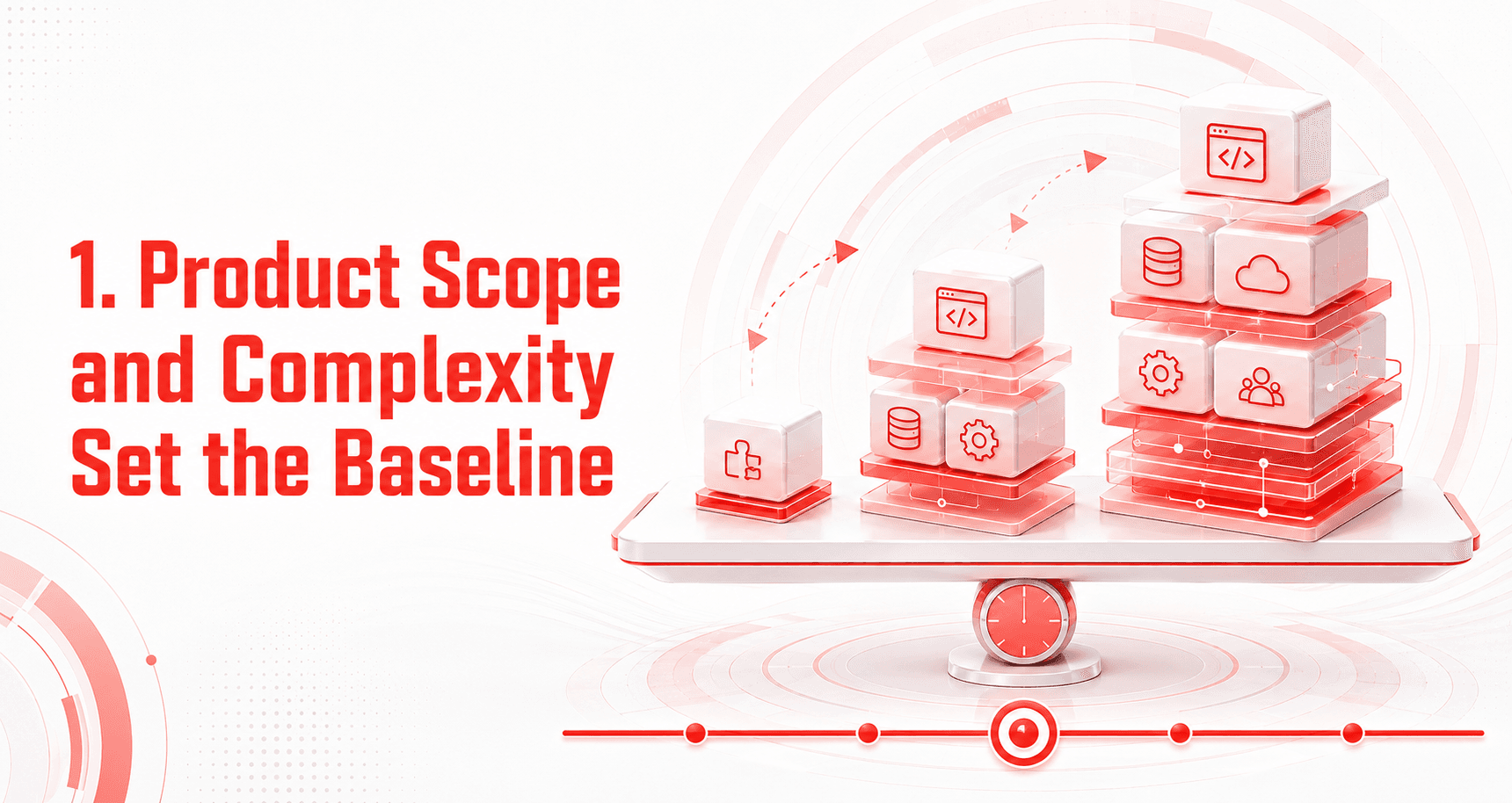
The first and largest cost driver is what the product must do.
A requirement such as “users can manage orders” may involve:
- Several order types.
- Custom pricing rules.
- Approval levels.
- Inventory validation.
- Tax calculations.
- Payment collection.
- Refunds.
- Shipping integrations.
- Notifications.
- Document generation.
- Reporting and audit logs.
Each exception, permission, automation, and integration creates design, development, testing, and maintenance work.
Features that commonly increase cost
- Multiple types of users.
- Advanced permission systems.
- Real-time functionality.
- Complex dashboards.
- Custom analytics.
- Subscription billing.
- Payment processing.
- AI or machine learning.
- Video or audio processing.
- Offline functionality.
- Native iOS and Android applications.
- Third-party system integrations.
- Large-scale data migration.
- Regulatory compliance.
- Multi-language support.
- High-availability infrastructure.
Number of screens is not enough
A quote based only on the number of screens can be misleading.
A single analytics dashboard may require more engineering than 15 simple content screens because it needs data aggregation, calculations, permissions, caching, filters, exports, and performance optimization.
A reliable estimate should describe:
- User roles.
- Workflows.
- Business rules.
- Data entities.
- Integrations.
- Non-functional requirements.
- Acceptance criteria.
- Items explicitly excluded from scope.
Once the scope is understood, the second major question is who will build it and under what commercial model.
2. Team Structure and Location Affect the Rate
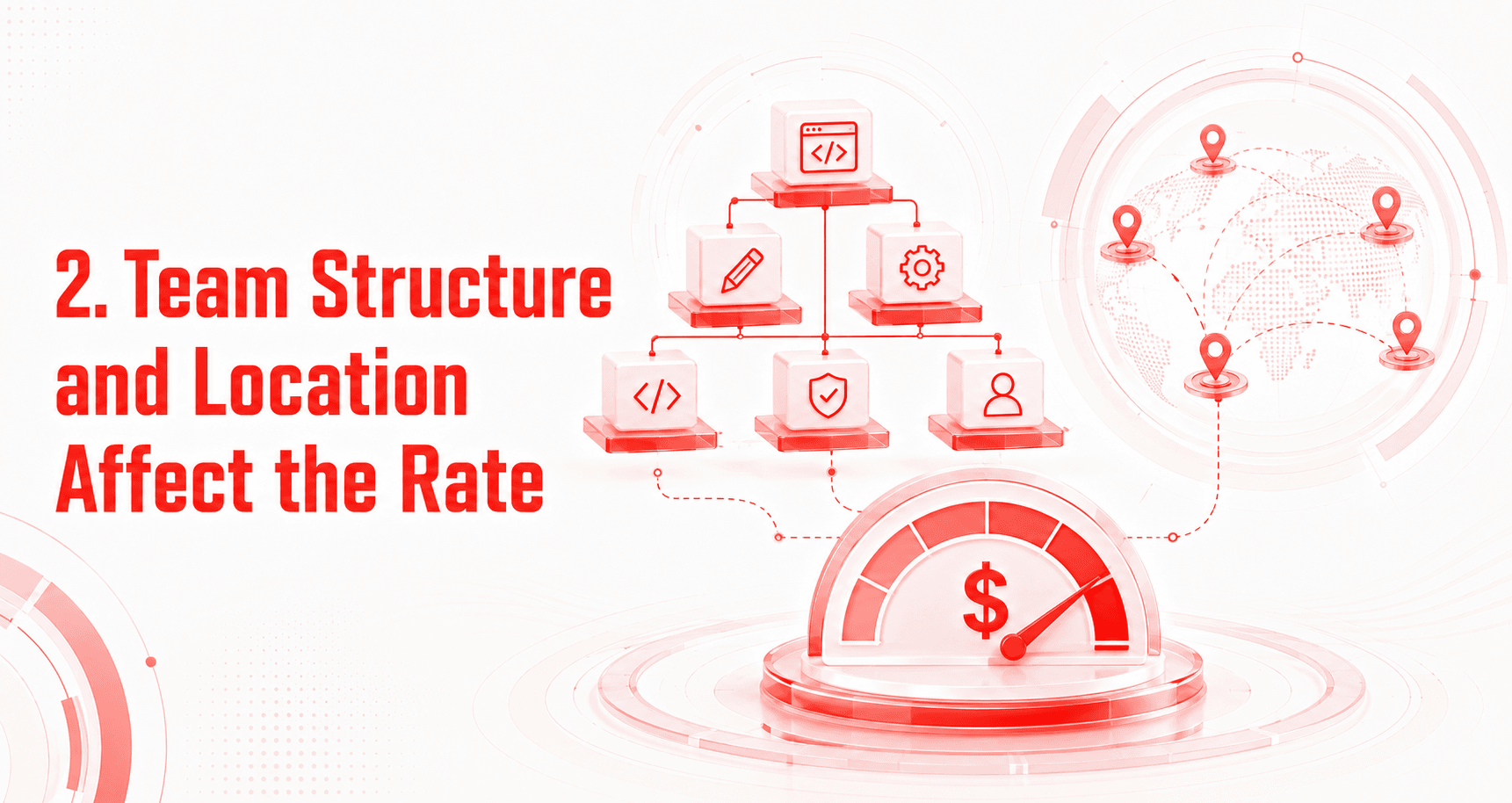
Custom software is not produced by developers alone. A complete delivery team may include:
- Product or project manager.
- Business analyst.
- UX/UI designer.
- Software architect.
- Frontend developer.
- Backend developer.
- Mobile developer.
- QA engineer.
- DevOps engineer.
- Security specialist.
Small projects may combine several responsibilities. Larger or regulated projects need dedicated specialists.
US software development rates in 2026
Clutch currently lists an average country-level range of approximately $50–$99 per hour for US software development providers, while specialized agencies and providers in major US technology markets frequently charge $100–$200+ per hour.
A practical market view is:
| Provider type | Typical hourly range |
|---|---|
| US independent developer | $75–$200 |
| Small US development studio | $100–$175 |
| Established US software agency | $125–$250+ |
| US-led distributed team | $60–$150 |
| Nearshore development team | $50–$120 |
| Offshore development team | $25–$80 |
Hourly rates alone do not predict the final cost.
A $60-per-hour team that requires 2,000 hours costs more than a $140-per-hour team that delivers the same result in 700 hours. Rework, unclear communication, weak architecture, and missing QA can remove the apparent savings of a lower rate.
Why US development is expensive
According to the US Bureau of Labor Statistics, the median annual wage for a US software developer was $133,080 in May 2024, before employer taxes, benefits, recruitment, management, equipment, and operational overhead.
That makes a capable in-house product team a significant fixed investment.
A single developer salary also does not cover design, product management, QA, DevOps, security, or periods of absence. This is why startups often use an external development partner until the product and business model justify building a complete internal team.
Freelancer, agency, or in-house team?
Freelancer
Best for:
- A narrow technical task.
- Short-term support.
- A prototype.
- Extending an existing team.
Risks include limited availability, knowledge concentration, and insufficient capacity for design, QA, infrastructure, and project management.
Software development agency
Best for:
- End-to-end product delivery.
- A defined MVP.
- Multiple technical disciplines.
- Fixed deadlines.
- Long-term maintenance.
An agency costs more per hour than a freelancer but can provide a complete team and structured delivery process.
In-house team
Best for:
- A mature product requiring continuous development.
- Organizations with strong technical leadership.
- Long-term strategic software ownership.
The challenge is recruitment time and the full cost of salaries, benefits, tools, management, and employee retention.
The provider affects the rate, while the engagement model determines who carries estimation and scope risk.
Fixed Price vs. Time and Materials vs. Dedicated Team
Fixed-price contract
A fixed-price model works when the scope and acceptance criteria are clear.
Advantages:
- Predictable initial budget.
- Defined delivery milestones.
- Easier financial approval.
- Vendor carries more estimation risk.
Limitations:
- Changes require formal change requests.
- The price may include a risk buffer.
- Poorly defined requirements can create disputes.
- Teams may optimize for scope completion rather than product learning.
Time and materials
The client pays for actual time used.
Advantages:
- Flexible scope.
- Suitable for product discovery.
- Easier to change priorities.
- Supports iterative development.
Limitations:
- Final cost is less certain.
- Requires active product ownership.
- Weak governance can allow costs to drift.
Dedicated team
A dedicated team works continuously for a monthly fee.
Advantages:
- Stable product knowledge.
- Predictable team capacity.
- Suitable for continuous development.
- Flexible roadmap.
Limitations:
- You pay for ongoing capacity.
- Requires enough work to justify the team.
- Strong product leadership is still necessary.
For many startups, a practical approach is a fixed discovery phase followed by a capped time-and-materials build or phased fixed-price implementation.
3. UX, Architecture, Integrations, and Data Shape the Build
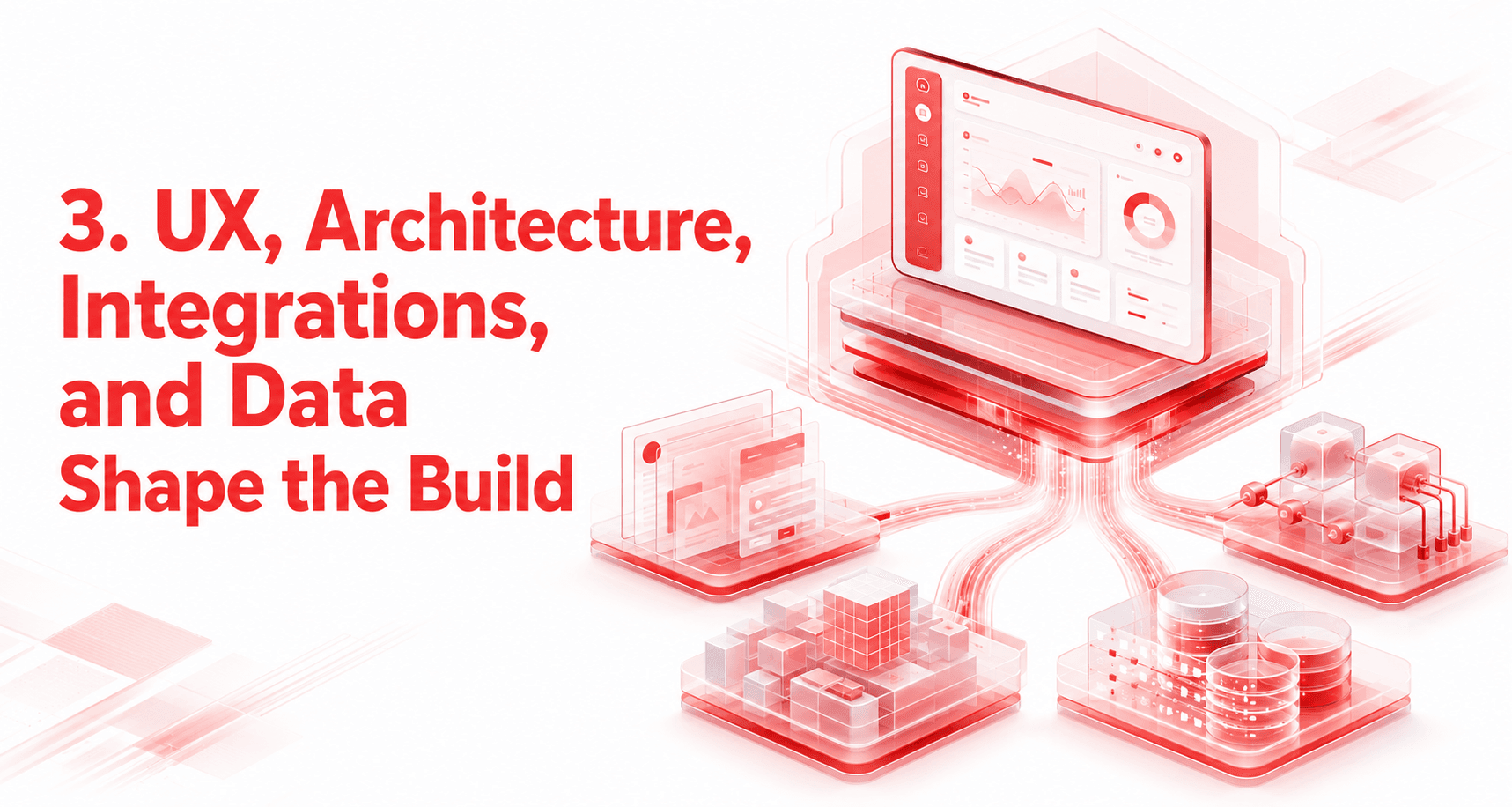
Once the team is selected, the next cost driver is the technical depth behind the visible features.
UX and product design
Professional product design may include:
- User research.
- User journey mapping.
- Wireframes.
- Interactive prototypes.
- Design systems.
- Responsive interface design.
- Accessibility planning.
- Usability testing.
Skipping design can appear to save money, but unclear workflows often produce expensive changes after development begins.
Technical architecture
Architecture decisions determine how the product handles:
- User growth.
- Data volume.
- Performance.
- Security.
- Background processing.
- Multiple organizations.
- Integrations.
- Availability.
- Future applications.
A small MVP does not need enterprise complexity. However, it needs a clean foundation that can evolve without a complete rewrite.
Third-party integrations
Common integrations include:
- Payment gateways.
- CRM and ERP systems.
- Accounting software.
- Identity providers.
- Email and SMS services.
- Analytics platforms.
- Maps and geolocation.
- Shipping systems.
- AI APIs.
- Customer support tools.
- Legacy databases.
A documented modern API may take several days to integrate. A poorly documented legacy system can require weeks of investigation, custom middleware, error handling, and testing.
Data migration
Data migration may require:
- Exporting legacy data.
- Cleaning duplicates.
- Mapping old fields to the new structure.
- Validating relationships.
- Transforming formats.
- Testing migration scripts.
- Planning downtime.
- Maintaining an audit trail.
Never assume migration is included unless the proposal states what data will be moved and how it will be verified.
After the product and architecture are defined, security and quality requirements can materially change both cost and schedule.
4. Security, Compliance, QA, and Deployment Add Necessary Cost
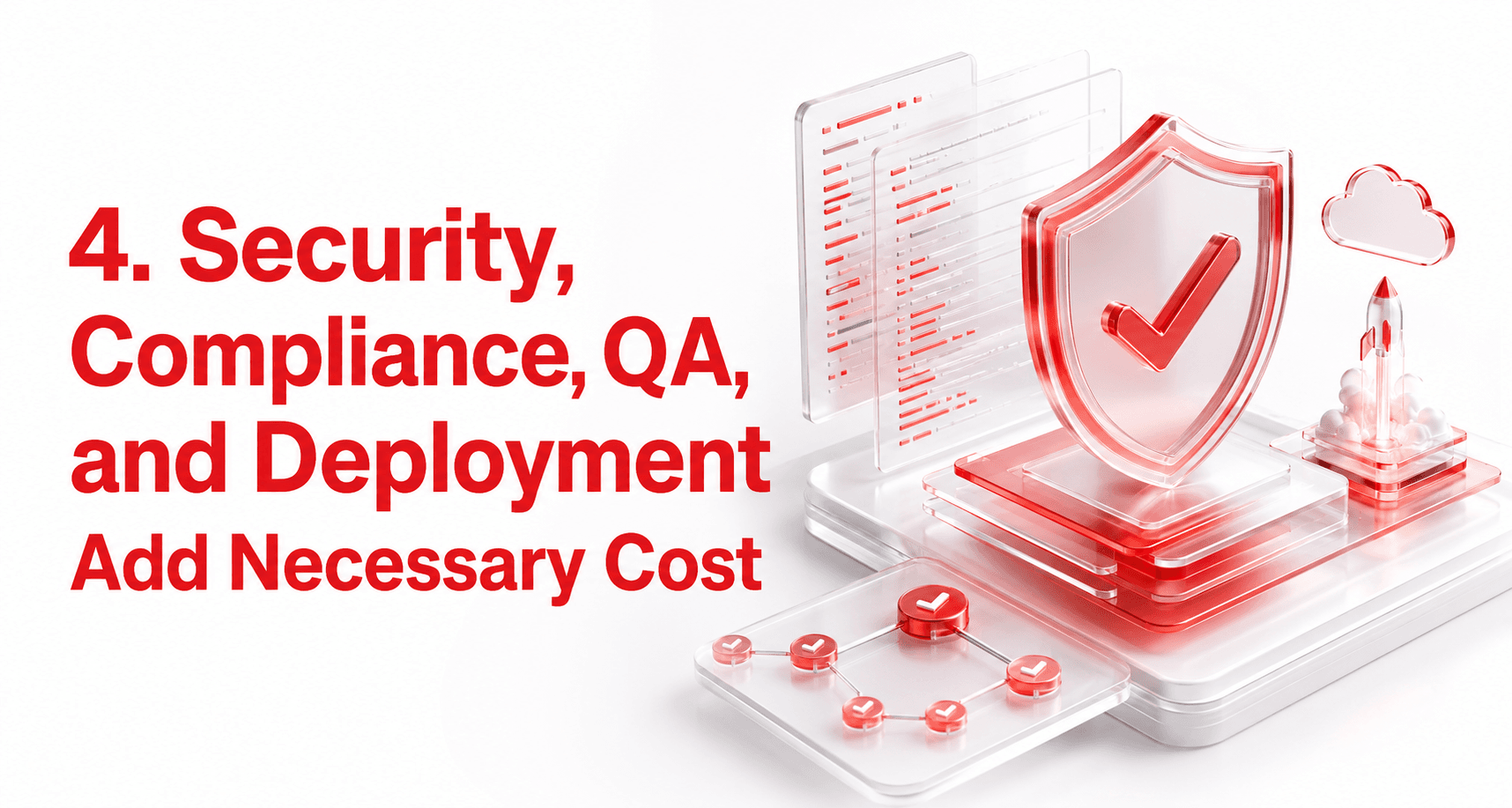
Security should be planned during architecture and development, not added immediately before launch.
The NIST Secure Software Development Framework provides practices for integrating security throughout the software development lifecycle.
Typical security work may include:
- Secure authentication.
- Role-based authorization.
- Encryption.
- Secret management.
- Audit logging.
- Dependency scanning.
- Code review.
- Rate limiting.
- Backup and recovery.
- Security monitoring.
- Vulnerability testing.
- Incident-response planning.
Compliance requirements
Costs may increase when software must support:
- HIPAA for healthcare data.
- PCI DSS for payment card environments.
- SOC 2 controls and evidence collection.
- State privacy requirements.
- Industry-specific retention rules.
- Accessibility requirements.
- Data residency obligations.
Compliance is not a single feature or certificate that a development team switches on. It affects product requirements, architecture, vendors, documentation, access controls, operations, and ongoing monitoring.
Your legal, security, and compliance specialists should determine which obligations apply.
Quality assurance
A production-ready budget should include:
- Functional testing.
- Integration testing.
- Browser and device testing.
- Permission testing.
- Regression testing.
- Performance testing.
- Security testing.
- User acceptance testing.
- Backup and restoration testing.
Cutting QA is one of the fastest ways to make an initial quote look cheaper. The cost usually returns after launch through bugs, support requests, customer churn, and emergency fixes.
DevOps and deployment
Deployment work may include:
- Cloud environment configuration.
- CI/CD pipelines.
- Domain and SSL configuration.
- Database setup.
- Logging and monitoring.
- Automated backups.
- Scaling rules.
- Staging and production environments.
- Release and rollback procedures.
The software must be operated after it is written. That brings the final cost driver: post-launch ownership.
5. Post-Launch Costs Determine the Total Cost of Ownership
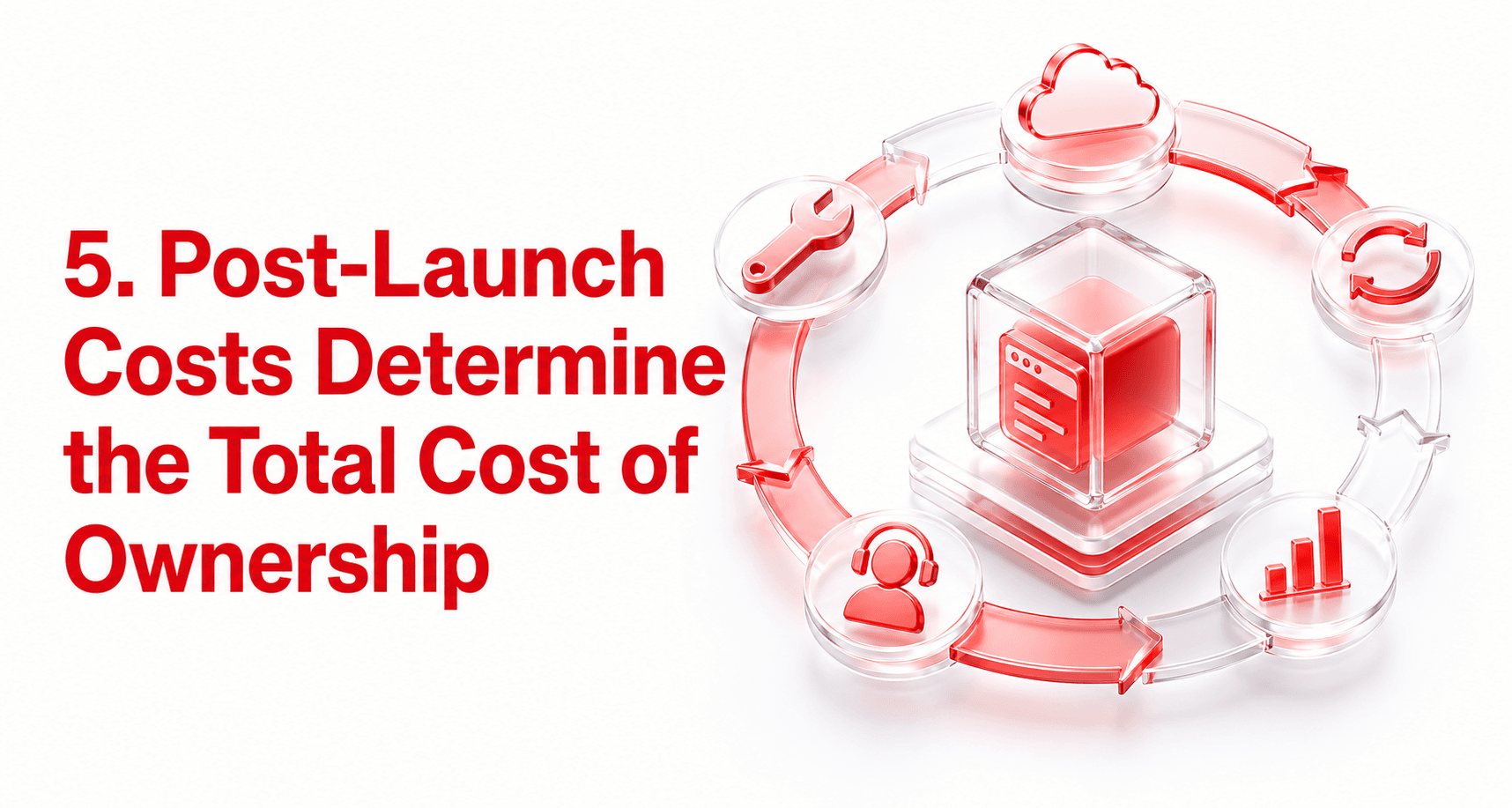
The development quote is not the lifetime cost of the product.
After launch, budget for:
- Cloud hosting.
- Database and storage.
- Email, SMS, and API usage.
- Monitoring and logging.
- Error tracking.
- Security updates.
- Dependency updates.
- Bug fixes.
- Customer support.
- Product analytics.
- New features.
- Performance improvements.
- Backups and disaster recovery.
- Compliance reviews.
A common planning rule is to reserve approximately 10%–25% of the initial build cost per year for maintenance, support, security, and incremental improvement. Fast-growing SaaS products may invest considerably more because continuous product development is part of the business model.
Typical monthly operating costs
| Product stage | Approximate monthly operating budget |
|---|---|
| Early internal tool | $500–$2,500 |
| Early-stage MVP | $1,000–$5,000 |
| Growing SaaS product | $3,000–$20,000+ |
| Enterprise platform | $10,000–$100,000+ |
These ranges can include infrastructure, third-party services, monitoring, maintenance, and support. They do not necessarily include a full-time product development team.
Products with AI processing, video, large data volumes, high traffic, or expensive third-party APIs can have substantially higher operating costs.
Sample 2026 Software Budgets
Example 1: Internal operations portal
Scope:
- Three user roles.
- Customer and order management.
- Approval workflow.
- Dashboard and reporting.
- One accounting integration.
- Data import.
- Responsive web interface.
Estimated budget:
| Phase | Estimated cost |
|---|---|
| Discovery and scope | $5,000–$10,000 |
| UX/UI design | $7,000–$15,000 |
| Development | $30,000–$65,000 |
| QA and integration testing | $7,000–$15,000 |
| Deployment and training | $3,000–$8,000 |
| Estimated total | $52,000–$113,000 |
Example 2: SaaS MVP
Scope:
- Multi-tenant accounts.
- Authentication and roles.
- Subscription billing.
- Core customer workflow.
- Customer and admin dashboards.
- Email notifications.
- Analytics.
- Cloud deployment.
Estimated budget:
| Phase | Estimated cost |
|---|---|
| Discovery and architecture | $8,000–$20,000 |
| UX/UI design | $12,000–$25,000 |
| Core product development | $55,000–$130,000 |
| Billing and integrations | $12,000–$35,000 |
| QA and security | $12,000–$30,000 |
| Deployment and launch | $5,000–$15,000 |
| Estimated total | $104,000–$255,000 |
Example 3: Enterprise operations platform
Scope:
- Multiple departments.
- Advanced roles and approvals.
- Legacy data migration.
- ERP and CRM integrations.
- Audit logs.
- Custom analytics.
- High availability.
- Compliance requirements.
- Training and phased rollout.
Estimated total: $250,000–$1,000,000+
The final range depends on how many existing systems must be replaced, the quality of the data, user volume, and regulatory requirements.
Hidden Costs Founders and CTOs Should Include
Before comparing proposals, check whether each quote includes:
- Discovery and requirements.
- Product management.
- UX/UI design.
- Technical architecture.
- QA and test automation.
- Data migration.
- Third-party integration fees.
- Cloud configuration.
- Monitoring and backups.
- Application-store fees.
- Security assessments.
- Compliance work.
- Documentation.
- User training.
- Warranty period.
- Post-launch support.
- Taxes and currency conversion.
- Ownership and code transfer.
A proposal can appear cheaper simply because important work has been excluded.
How to Reduce Custom Software Development Costs
1. Define one measurable product outcome
Do not begin with a list of 50 features. Define the business result the first release must achieve.
Examples include:
- Reduce order-processing time by 40%.
- Replace three spreadsheets.
- Allow customers to complete onboarding without staff assistance.
- Validate paid demand for a SaaS concept.
- Provide management with real-time operational reporting.
2. Prioritize the MVP ruthlessly
Divide features into:
- Must have for launch.
- Important after validation.
- Future enhancement.
- Not currently required.
Every feature added to version one also creates additional design, development, testing, documentation, and maintenance work.
3. Validate complex workflows with a prototype
Changing a prototype is far less expensive than rebuilding completed software.
Test important journeys with users before development begins.
4. Use existing services selectively
Authentication, payments, email, analytics, search, and file storage do not always need to be built from scratch.
Use proven services when they reduce risk, but calculate their long-term usage costs and switching limitations.
5. Build in phases
A phased roadmap reduces initial investment and allows evidence from real users to guide later spending.
A practical roadmap may be:
- Discovery and prototype.
- Core MVP.
- Pilot launch.
- Product improvement.
- Scale and automation.
6. Assign an empowered product owner
Slow decisions, conflicting feedback, and unavailable stakeholders create billable delays.
One product owner should have authority to prioritize work and approve decisions.
7. Compare total proposals, not hourly rates
Ask each vendor to explain:
- Deliverables.
- Team composition.
- Estimated hours.
- Assumptions.
- Exclusions.
- QA approach.
- Ownership.
- Support.
- Change-request process.
A higher rate with a stronger team and clearer scope can produce a lower total cost.
How Neutrons Prices Custom Software
Neutrons provides custom software development for startups and established businesses, including web applications, internal tools, APIs, workflow automation, MVPs, and system modernization.
Our process includes:
- Discovery and scope definition.
- UX design and scalable architecture.
- Development in short, reviewable sprints.
- Testing, deployment, and launch.
- Ongoing maintenance and product support.
Neutrons provides a clear, fixed-price proposal when the scope is sufficiently defined. Every quote is based on the required features, integrations, complexity, and timeline rather than a generic package.
Clients receive ownership of the source code, design files, and infrastructure created for their project, helping reduce vendor lock-in.
Explore our custom software development service, review our portfolio, or see our case studies.
Questions to Ask Before Accepting a Quote
Ask every development partner:
- What is included and excluded?
- How was the estimate calculated?
- Who will work on the project?
- Is UX/UI design included?
- How will the product be tested?
- Who owns the source code?
- Will we have repository and cloud access?
- How are scope changes priced?
- What happens if the timeline changes?
- Is data migration included?
- What security practices are followed?
- What support is available after launch?
- Can another team maintain the software?
- Which third-party costs are not included?
- What assumptions could change the price?
The quality of the answers is often more informative than the quoted rate.
Frequently Asked Questions
1 - How much does custom software development cost in the USA in 2026?
A focused project may cost $25,000–$75,000, a production-ready MVP may cost $40,000–$120,000, and complex business or SaaS platforms often range from $100,000 to $500,000 or more.
2 - What is the average hourly rate for software development in the USA?
US rates vary by location, specialization, and provider. Country-level Clutch listings commonly show $50–$99 per hour, while established US agencies and senior specialists may charge $100–$250 or more.
3 - How much does a custom software MVP cost?
A practical 2026 budget for a production-ready MVP is approximately $40,000–$120,000. SaaS MVPs with subscriptions, multiple roles, dashboards, and integrations may cost $80,000–$250,000.
4 - How long does custom software development take?
A focused MVP may take approximately 8–16 weeks. Larger platforms can require six months or longer. Neutrons reports a typical range of 6–16 weeks for many defined custom software projects.
5 - Is custom software more expensive than SaaS subscriptions?
Custom software usually costs more initially. It may become more economical when it replaces multiple subscriptions, reduces manual labor, supports a unique workflow, or creates a sellable product.
6 - Should a startup hire freelancers or a software agency?
Freelancers can work well for narrow tasks or prototypes. An agency is generally more suitable when the project requires product management, UX, architecture, development, QA, DevOps, and ongoing support.
7 - Does the client own custom software?
Ownership depends on the contract. Make sure it explicitly covers source code, designs, documentation, databases, and infrastructure. Neutrons provides clients with ownership of the project assets developed for them.
8 - How much should we budget for software maintenance?
A common planning range is 10%–25% of the original development budget per year. Products under active development may require a larger ongoing budget.
9 - Can AI reduce the cost of software development?
AI-assisted tools can speed up planning, coding, and testing, but they do not remove the need for architecture, security, review, QA, and product judgment. AI features inside the product can also increase infrastructure and testing costs.
10 - How can we get an accurate custom software quote?
Prepare your business objective, user types, core workflows, integrations, expected usage, timeline, and must-have features. A short discovery phase can convert these requirements into an estimate and delivery plan.
Get a Custom Software Cost Estimate
The custom software development cost in the USA depends on much more than an hourly rate. Scope, architecture, integrations, security, team structure, and post-launch ownership determine the real investment.
A clear estimate should show what will be built, how it will be tested, when it will be delivered, and what happens after launch.
If you are planning an MVP, SaaS product, internal system, CRM, ERP, or business automation platform, contact Neutrons for a free consultation and a transparent project estimate.