Blog
Compare custom and off-the-shelf software across cost, implementation speed, scalability, security, integrations, and long-term ownership.
Custom Software vs Off-the-Shelf Software: Which Is Right for Your Business?
Choosing between custom software vs off-the-shelf software is not simply a technical decision. It affects your operating costs, launch timeline, ability to scale, customer experience, data ownership, and long-term competitive advantage.
Off-the-shelf software can get a business running quickly with a lower initial commitment. Custom software requires more planning and a larger upfront investment, but it can support unique workflows, proprietary products, complex integrations, and long-term growth without forcing the business into a vendor’s predefined model.
The best option depends on one central question:
Is the software supporting a standard business function, or is it helping create your competitive advantage?
If you are solving a common problem such as payroll, accounting, email marketing, or internal communication, an established product may be the most efficient choice. If the software represents your product, intellectual property, customer experience, or operational advantage, custom development becomes more compelling.
The short answer
Choose off-the-shelf software when:
- Your requirements are standard.
- You need to deploy quickly.
- An existing product meets most requirements without significant workarounds.
- The software does not differentiate your company.
- Your team prefers vendor-managed maintenance and updates.
Choose custom software when:
- Your business depends on unique workflows or automation.
- The software itself is your product.
- Existing platforms require expensive workarounds.
- You need deep integrations or a specialized data model.
- Ownership, flexibility, and roadmap control are strategically important.
For many growing companies, the best solution is a hybrid approach: buy established tools for commodity capabilities and build the workflows, integrations, and user experiences that make the business different.
This guide evaluates the decision across five connected areas.
1. Start With Business Fit and Strategic Value

The first step in a custom software vs off-the-shelf software decision is determining how closely an existing product fits the way your business actually operates.
What is off-the-shelf software?
Off-the-shelf software is a ready-made product designed for a broad group of customers. Examples include CRM systems, project management platforms, accounting tools, e-commerce platforms, and HR applications.
These products usually provide:
- Prebuilt features
- Subscription-based pricing
- Standard integrations
- Documentation and customer support
- Regular vendor-managed updates
- A relatively fast implementation process
The advantage is speed. Your company can start using a proven solution without financing an entire product development cycle.
The disadvantage is that your workflows may need to adapt to the software. As requirements become more specialized, teams often add plugins, spreadsheets, manual approvals, external databases, or separate applications to fill the gaps.
What is custom software?
Custom software is designed around the requirements of a specific organization, product, or user group. It may be an internal business application, customer portal, operations platform, mobile app, SaaS product, integration layer, or data platform.
With custom software development, the workflow, permissions, architecture, interfaces, and integrations can be designed around the business rather than around a generic market.
This is especially valuable when the software supports:
- Proprietary processes
- A unique customer experience
- Complex operational logic
- Specialized compliance requirements
- Multiple system integrations
- A new SaaS or digital product
- Business automation at scale
The strategic-value test
Ask the following question:
If a competitor purchased the same software tomorrow, would we still have a meaningful operational or product advantage?
If the answer is yes, off-the-shelf software may be sufficient.
If the answer is no because the workflow, data, automation, or customer experience is part of your competitive advantage, a custom solution deserves serious consideration.
A practical comparison
| Decision area | Off-the-shelf software | Custom software |
|---|---|---|
| Initial availability | Usually faster | Requires discovery and development |
| Upfront investment | Usually lower | Usually higher |
| Workflow fit | Based on standard workflows | Designed around your workflows |
| Customization | Limited by vendor and product | Controlled by your roadmap |
| Integrations | Prebuilt or vendor-supported | Can be designed for specific systems |
| Ownership | Vendor owns the product | Contract can provide code and IP ownership |
| Maintenance | Primarily handled by vendor | Handled by your team or development partner |
| Differentiation | Limited | Can create proprietary value |
| Vendor dependency | Typically higher | Depends on architecture and contract |
| Scalability | Based on vendor plans and limits | Designed around expected growth |
Once business fit is understood, the next step is determining whether the economics support the choice.
2. Compare Time to Value and Total Cost of Ownership
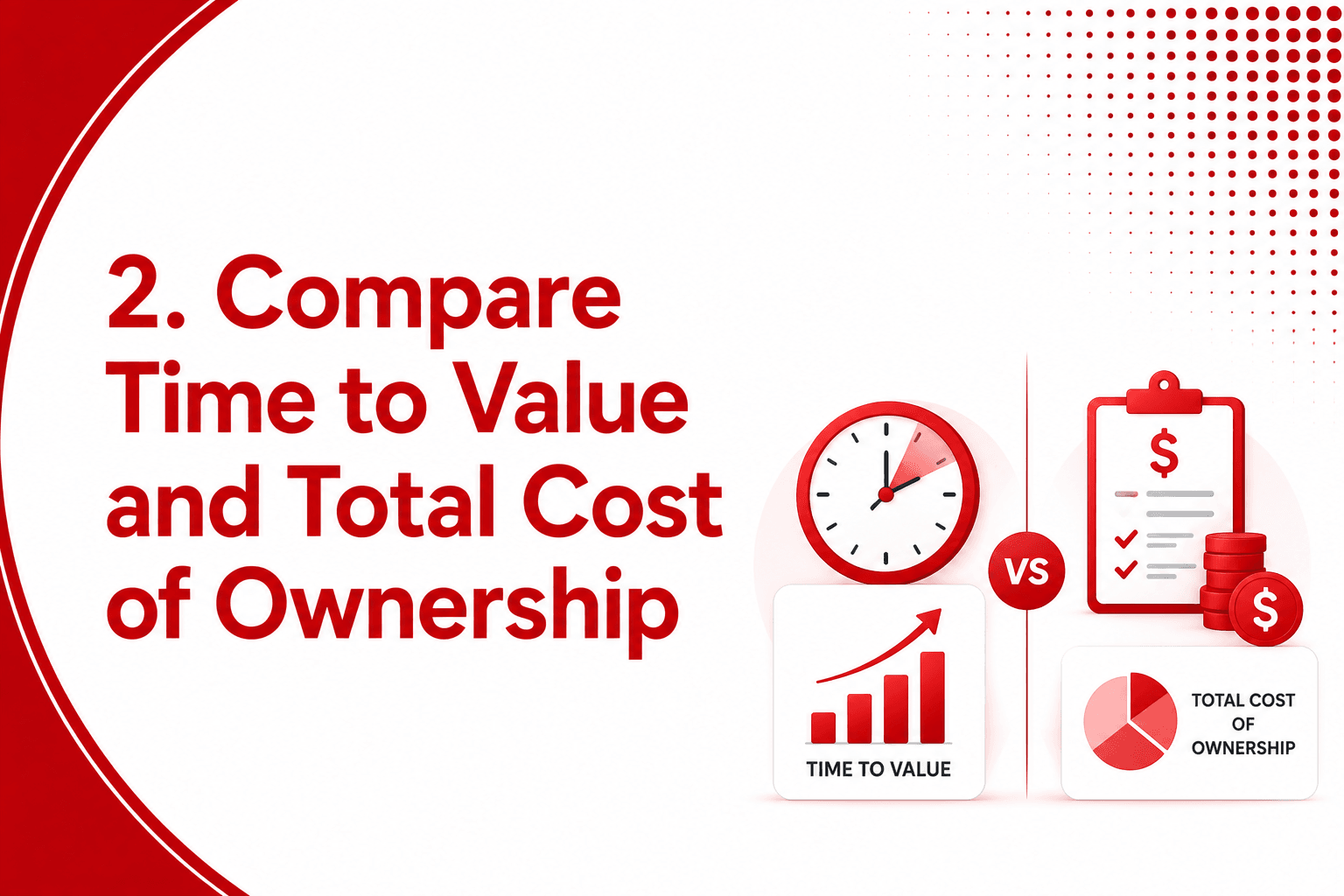
The purchase price or development quote does not show the complete financial impact of a software decision.
Off-the-shelf software normally has a lower entry cost. However, subscriptions, per-user fees, implementation services, integrations, add-ons, training, and administrative work can significantly increase the long-term total.
Custom software has a larger upfront cost, but it may reduce recurring license fees, remove manual work, consolidate multiple systems, and support growth without repeatedly changing platforms.
What does off-the-shelf software really cost?
The total cost may include:
- Monthly or annual subscription fees
- Per-user or usage-based charges
- Premium feature packages
- Implementation consultants
- Data migration
- Custom integrations
- Employee training
- Internal administration
- Process workarounds
- Contract price increases
- Switching and data-export costs
A platform that appears inexpensive with ten users may become materially more expensive with 100 or 1,000 users.
For example, a hypothetical product priced at $75 per user per month would create $450,000 in subscription fees over five years for 100 users:
100 users × $75 × 60 months = $450,000
That figure does not include implementation, integrations, training, add-ons, or internal administration. This is only an illustrative calculation; actual vendor pricing and requirements will differ.
What does custom software really cost?
Custom software costs can include:
- Product discovery
- UX and interface design
- Software engineering
- Quality assurance
- Cloud infrastructure
- Security testing
- Data migration
- Deployment
- Monitoring and support
- Ongoing enhancements
Custom development should not be treated as a one-time expense. Every production application needs monitoring, updates, backups, security maintenance, and continued improvement.
However, custom software can also create measurable returns by:
- Automating repetitive work
- Reducing software subscriptions
- Eliminating duplicate data entry
- Consolidating disconnected systems
- Shortening operational cycles
- Improving customer conversion or retention
- Supporting a new revenue-generating product
Use a three-to-five-year TCO model
A useful comparison formula is:
Total cost of ownership = implementation + licenses + integrations + customization + infrastructure + support + training + migration + internal labor + expected switching cost
Build two scenarios covering at least three years. Five years is better for systems expected to become central to the business.
Do not compare an off-the-shelf monthly fee with only the initial custom development quote. Compare the complete cost of achieving and maintaining the same business outcome.
Time to value
Off-the-shelf products can sometimes be configured within days or weeks. Complex enterprise implementations can still take several months when they require data migration, permissions, integrations, and employee training.
A focused custom MVP often takes approximately 8–16 weeks. Broader platforms with complex integrations, compliance requirements, or multiple user groups may require four to twelve months or more.
The right timeline depends on scope. A phased custom launch can deliver the highest-value workflow first rather than waiting for every planned feature.
Now that cost and timing are visible, the next question is whether each option can support the company’s future architecture and growth.
3. Evaluate Scalability, Integrations, Data, and Ownership
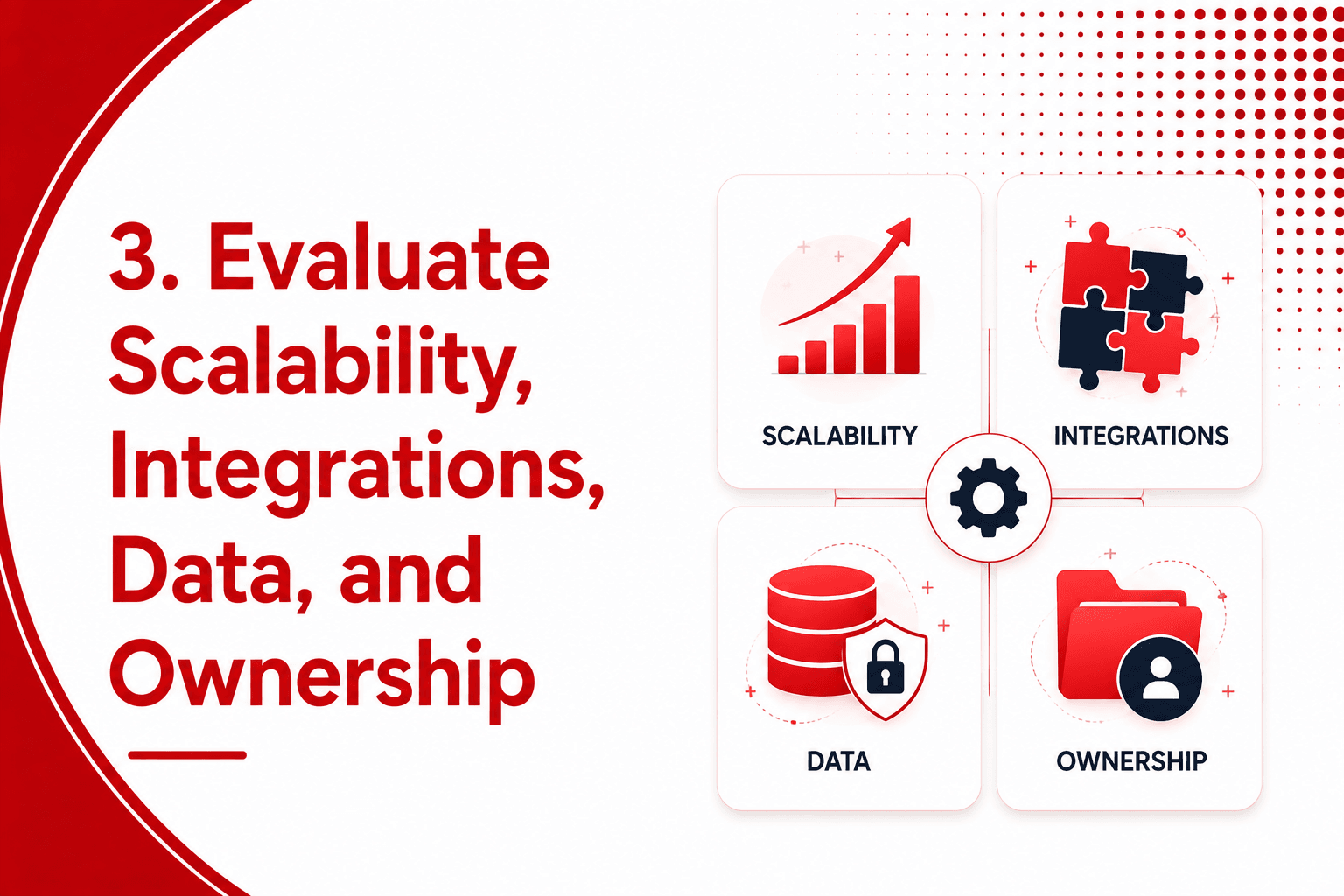
Software that works today can become a constraint when transaction volume, users, locations, data, or product complexity increases.
Scalability with off-the-shelf software
Established software vendors may offer strong infrastructure, global availability, and enterprise plans. The technical platform may scale effectively, but your commercial and operational freedom remains connected to the vendor’s model.
Potential constraints include:
- Per-user price increases
- API rate limits
- Storage limits
- Restricted data models
- Limited automation
- Unsupported integrations
- Features locked behind higher plans
- Changes to product functionality
- Limited control over the vendor roadmap
Before purchasing, evaluate the plan you will need at your expected scale—not only the plan that fits the business today.
Scalability with custom software
Custom software can be designed around projected transaction volume, usage patterns, geographic requirements, permissions, and reporting needs.
That does not mean a custom platform scales automatically. Scalability depends on architecture, engineering quality, infrastructure, observability, database design, and ongoing testing.
For SaaS products, the AWS SaaS Lens provides useful architecture guidance covering reliability, security, operational excellence, performance, and cost optimization.
Companies planning a subscription product can also evaluate dedicated SaaS platform development rather than adapting a general-purpose application into a customer-facing product.
Integration requirements
Off-the-shelf software is effective when the systems you use are already supported. Problems appear when the business depends on legacy software, proprietary databases, industry-specific equipment, or multiple platforms with inconsistent data.
Warning signs include:
- Employees copying information between applications
- Critical operations being coordinated through spreadsheets
- Customers entering the same information more than once
- Reports requiring manual data consolidation
- Teams building unofficial workarounds around API limits
- Important processes depending on one employee’s knowledge
A custom integration layer can connect existing products without requiring the company to replace every system. This makes a hybrid architecture attractive for many mid-market and enterprise organizations.
Data ownership and portability
Clarify these questions before signing a software agreement:
- Who owns the business and customer data?
- Can the data be exported in a usable format?
- Are API access and exports included in the current plan?
- What happens to the data when the contract ends?
- How long does the vendor retain deleted information?
- Can the business move to another provider?
- Who owns custom configurations and integrations?
With custom software, your contract should clearly define ownership of source code, documentation, infrastructure, designs, and intellectual property. It should also specify repository access, deployment rights, and transition support.
The Syncentra SaaS case study shows how a purpose-built platform can connect a specialized business model with its own product experience and technical roadmap.
Greater control can create strategic value, but it also creates responsibility. That brings the comparison to security, maintenance, and operational risk.
4. Measure Security, Compliance, Maintenance, and Risk
Neither custom nor off-the-shelf software is automatically more secure.
A mature software vendor may have a dedicated security team, tested infrastructure, formal certifications, and established incident-response procedures. A poorly selected vendor may lack transparency, secure development controls, reliable backups, or acceptable data-handling policies.
Custom software gives your company greater control over architecture and security requirements, but that control is valuable only when the application is designed, tested, monitored, and maintained properly.
Security responsibilities with off-the-shelf software
The vendor typically manages:
- Application updates
- Infrastructure maintenance
- Vulnerability patches
- Platform monitoring
- Availability
- Product-level security controls
Your company remains responsible for:
- User access
- Permissions
- Configuration
- Employee devices
- Data classification
- Third-party integrations
- Account lifecycle management
- Vendor risk assessment
Before selecting a vendor, request evidence covering security practices, incident response, backups, data encryption, access controls, business continuity, and relevant compliance requirements.
CISA’s guidance for choosing secure and verifiable technologies can help organizations assess digital products during procurement.
Security responsibilities with custom software
A custom solution should include security throughout the software lifecycle rather than adding it shortly before launch.
The process should cover:
- Threat modeling
- Secure architecture
- Authentication and authorization
- Encryption
- Dependency management
- Code review
- Automated testing
- Vulnerability management
- Logging and monitoring
- Backup and recovery
- Incident response
- Regular updates
The NIST Secure Software Development Framework provides a structured set of secure software development practices. The OWASP Application Security Verification Standard provides testable application security requirements that can also be referenced in vendor agreements and acceptance criteria.
Maintenance and continuity
For off-the-shelf software, evaluate:
- Vendor financial stability
- Product update frequency
- Support response times
- Service-level commitments
- Product roadmap
- Export options
- Contract termination terms
- History of discontinued features
For custom software, evaluate:
- Code quality and documentation
- Automated test coverage
- Repository ownership
- Deployment documentation
- Infrastructure access
- Monitoring and alerting
- Support agreements
- Ability to change development partners
A custom application should not depend on one developer’s undocumented knowledge. Your organization should have sufficient documentation, access, and contractual rights to maintain continuity.
With the key risks visible, you can use a structured decision framework instead of relying on assumptions.
5. Use a Decision Scorecard—and Consider a Hybrid Approach
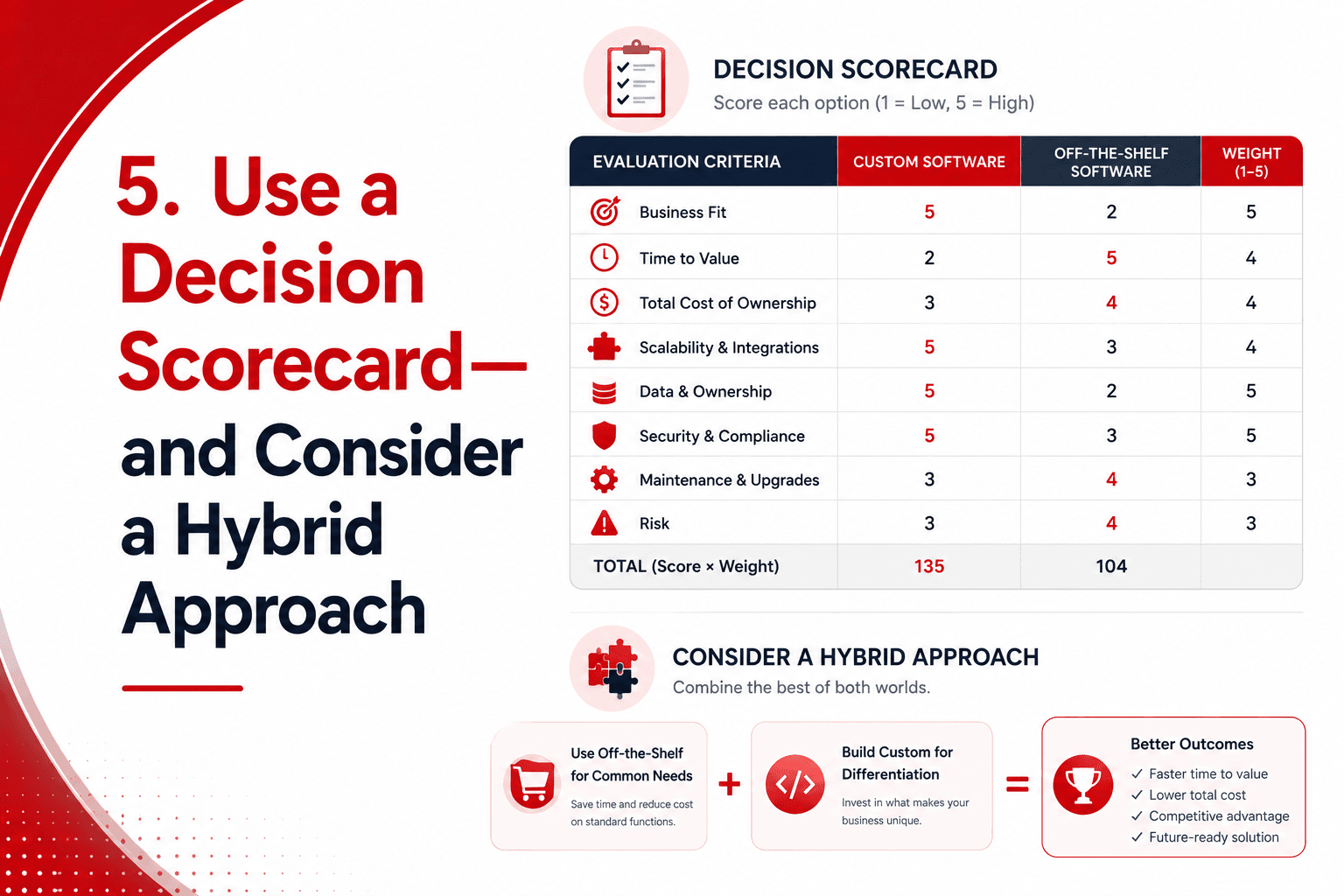
The final custom software vs off-the-shelf software choice should be based on weighted business requirements.
Decision scorecard
Score each option from 1 to 5 for every category. Multiply the score by the suggested weight.
| Evaluation category | Suggested weight | Questions to ask |
|---|---|---|
| Business and workflow fit | 25% | Can the solution support critical processes without major workarounds? |
| Integration and data requirements | 20% | Can it connect reliably with current and planned systems? |
| Three-to-five-year TCO | 20% | What is the complete cost at expected scale? |
| Time to value | 15% | How quickly can the business achieve a measurable outcome? |
| Security and operational risk | 10% | Can the solution satisfy security, compliance, and continuity requirements? |
| Ownership and roadmap control | 10% | How important are code ownership, portability, and release control? |
The weights can be changed according to your priorities. A regulated organization may increase the security category. An early-stage startup validating demand may give more weight to time to value.
Choose off-the-shelf software when
Off-the-shelf software is usually appropriate when:
- The process is common across many companies.
- At least 80% of important requirements are supported without complex workarounds.
- The business needs a solution immediately.
- The vendor provides the necessary integrations.
- Subscription costs remain reasonable at the expected user count.
- The software is not central to your competitive differentiation.
- Internal technical resources are limited.
Examples may include accounting, payroll, standard CRM, help-desk software, internal communication, and project management.
Choose custom software when
Custom development becomes more attractive when:
- The software is the company’s product or revenue engine.
- A unique workflow creates competitive advantage.
- Existing products cannot support essential requirements.
- The business needs a proprietary customer experience.
- Multiple systems require deep integration.
- Manual workarounds create significant cost or risk.
- Per-user or usage-based pricing becomes restrictive at scale.
- Product roadmap and data ownership are strategically important.
- The company expects requirements to evolve rapidly.
Choose a hybrid approach when
Many companies do not need a completely custom technology stack.
A practical hybrid model is to buy proven tools for commodity functions and build the differentiating layer.
For example, a business might use established providers for:
- Authentication
- Payments
- Email delivery
- Accounting
- Monitoring
- Cloud infrastructure
- Customer support
It can then build custom capabilities for:
- Proprietary workflows
- Customer portals
- Specialized automation
- Business rules
- Reporting
- Data products
- System integrations
- Unique user experiences
This approach can reduce development time while preserving control over the parts of the product that create business value.
When should you replace an off-the-shelf product?
Migration may be justified when:
- Workarounds require substantial manual labor.
- The software restricts product or operational growth.
- Teams maintain multiple disconnected systems.
- Subscription costs are increasing faster than delivered value.
- Important integrations are unavailable or unreliable.
- Customers are affected by workflow limitations.
- Data access or portability is inadequate.
- The vendor roadmap no longer aligns with your strategy.
Before replacing the platform, document the current workflow, quantify its costs, identify essential integrations, and define measurable outcomes for the new solution.
Final Verdict: Build What Differentiates You and Buy What Does Not
There is no universal winner in the custom software vs off-the-shelf software comparison.
Off-the-shelf software provides speed, predictable initial implementation, and vendor-managed maintenance. It is often the right choice for standardized functions that do not create a competitive advantage.
Custom software provides workflow fit, roadmap control, proprietary value, and deeper integration potential. It becomes more valuable when software is central to the product, customer experience, or operating model.
The strongest decision is usually based on four principles:
- Buy standardized capabilities that established products already solve well.
- Build the workflows and experiences that make your company different.
- Compare three-to-five-year total cost instead of initial price.
- Evaluate security, ownership, integration, and exit risk before committing.
If the decision is still unclear, start with a technical discovery phase. Map the workflows, requirements, integrations, risks, and expected business outcomes before choosing a platform or committing to custom development.
Contact Neutrons to evaluate your requirements and determine whether an off-the-shelf, custom, or hybrid software strategy provides the strongest business case.
Frequently Asked Questions
What is the main difference between custom and off-the-shelf software?
Off-the-shelf software is built for a broad market and provides standardized features. Custom software is designed for a particular company, workflow, product, or user group.
Which is cheaper: custom software or off-the-shelf software?
Off-the-shelf software usually has a lower upfront cost. Custom software may become financially attractive when recurring licenses, manual workarounds, integrations, and scaling costs make the packaged product expensive over several years.
How long does custom software development take?
A focused MVP may take approximately 8–16 weeks. More complex platforms can require four to twelve months or longer. The timeline depends on scope, integrations, security requirements, team size, and decision speed.
Is off-the-shelf software more secure?
Not automatically. Established vendors may have mature security programs, but security quality varies. Buyers should evaluate the vendor’s controls, data practices, incident response, access management, and compliance evidence.
Is custom software more secure?
Custom software provides control over security requirements and architecture, but it is secure only when supported by strong engineering, testing, monitoring, patching, and incident-response practices.
Who owns custom software?
Ownership depends on the development contract. The agreement should clearly define ownership of source code, intellectual property, designs, infrastructure, documentation, and deployment assets.
Can off-the-shelf software be customized?
Many products support configuration, extensions, plugins, and integrations. However, customization remains limited by the vendor’s architecture, APIs, pricing plans, and roadmap.
When should a startup build custom software?
A startup should consider custom development when software is the product, when a unique customer experience is essential, or when an existing platform cannot validate the core business proposition.
What is a hybrid software approach?
A hybrid approach combines established third-party tools with custom-built workflows, integrations, interfaces, or business logic. It helps companies avoid rebuilding commodity capabilities while retaining control over differentiating features.
How do you calculate software total cost of ownership?
Include implementation, subscriptions, development, integrations, cloud infrastructure, support, training, migration, internal administration, manual workarounds, and expected switching costs over three to five years.
When should a company replace off-the-shelf software?
Consider replacement when the product creates costly workarounds, blocks growth, increases operational risk, cannot support essential integrations, or no longer provides acceptable value at the company’s scale.
Can custom software integrate with existing applications?
Yes. Custom software can connect with existing systems through APIs, webhooks, integration platforms, direct database connections, or purpose-built middleware, depending on the systems and security requirements.