Blog
A realistic SaaS MVP usually takes 8–16 weeks. Learn what affects the timeline, how each development phase works, and how to launch faster without creating expensive technical debt.
How Long Does It Take to Build a SaaS MVP?
How long does it take to build a SaaS MVP? A focused, production-ready SaaS MVP typically takes between 8 and 16 weeks to design, develop, test, and launch.
A highly focused MVP with one core workflow and limited integrations may launch in 6–12 weeks. A more advanced B2B SaaS product with multi-tenant architecture, subscription billing, multiple roles, third-party integrations, or compliance requirements may take 4–8 months.
The timeline depends less on the number of screens and more on what the product must do behind those screens.
A realistic first estimate is:
| Type of product | Estimated timeline |
|---|---|
| Clickable product prototype | 2–4 weeks |
| Technical proof of concept | 4–8 weeks |
| Focused SaaS MVP | 6–12 weeks |
| Production-ready B2B SaaS MVP | 10–16 weeks |
| SaaS MVP with complex integrations | 4–8 months |
| Regulated or enterprise SaaS platform | 6–12+ months |
These ranges assume that the product scope is defined, stakeholders can make decisions quickly, and an experienced product team is available.
A SaaS MVP timeline can be understood through five connected factors:
- Product scope and validation: what must the first version prove?
- Features and SaaS architecture: what technical foundations are required?
- Team structure and decision speed: who is building the product and removing blockers?
- Testing, security, and launch readiness: what must be completed before real customers can use it?
- Release strategy and scope control: how can the product launch faster without requiring an expensive rebuild?
Understanding the first factor—scope—is essential because an unclear MVP can expand into a full platform before the first customer ever uses it.
1. Product Scope Determines the SaaS MVP Timeline
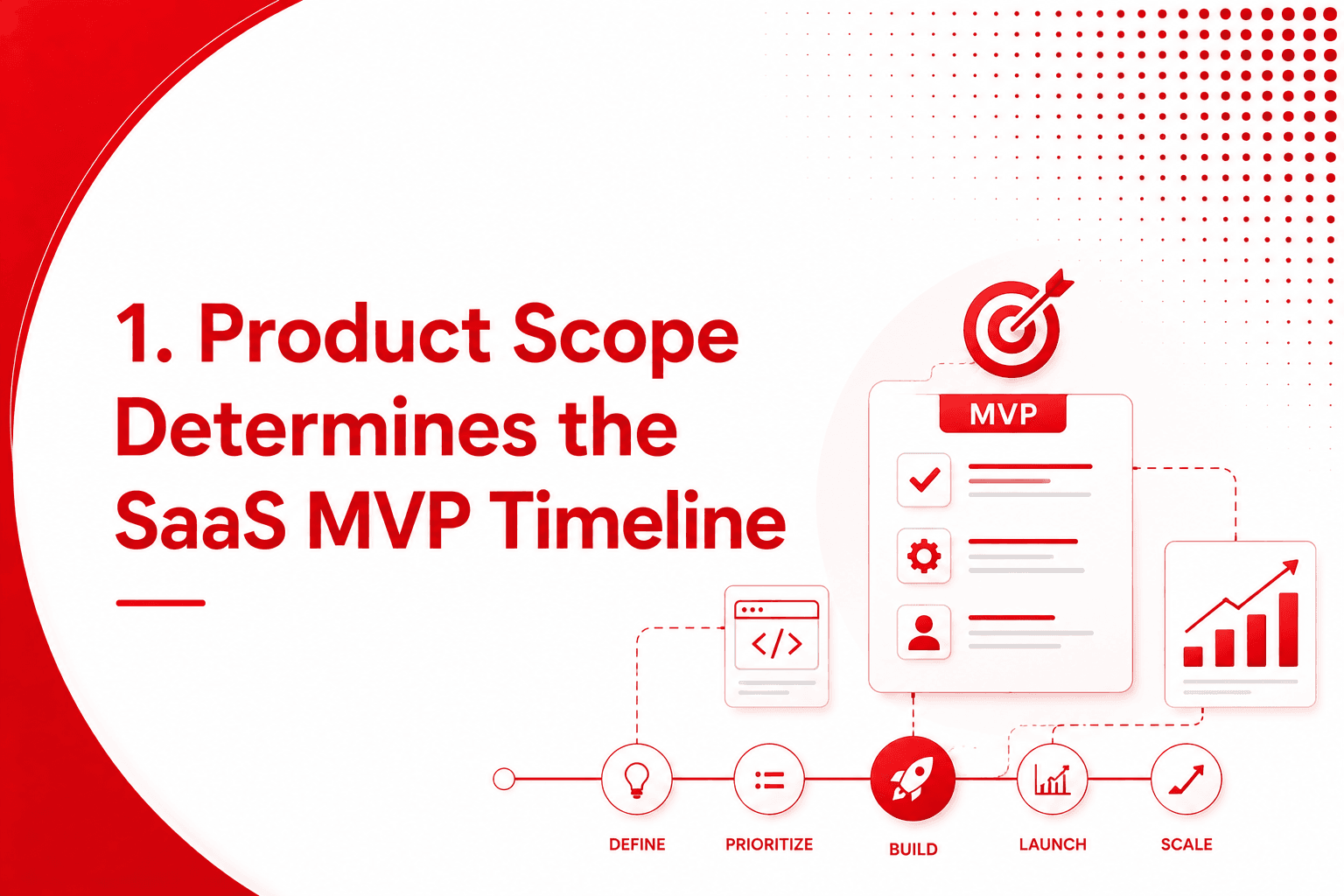
The first question should not be, “How quickly can developers start coding?” It should be, “What does this MVP need to prove?”
An MVP should test a business assumption with real users. It is not a smaller version of every feature in the long-term product roadmap.
For example, a SaaS founder may need to prove that:
- Customers have a painful and recurring problem
- Users can complete the core workflow
- Companies are willing to pay for the solution
- A specific onboarding process works
- A new automation saves measurable time
- A certain pricing model is viable
- The product can replace a manual process
- Users return after their initial session
Each assumption requires a different MVP.
Prototype vs. proof of concept vs. MVP
These three deliverables are frequently confused.
Product prototype
A prototype demonstrates the intended user experience. It may include clickable screens and realistic user flows, but it usually does not include a complete backend.
A prototype is useful for:
- User interviews
- Investor presentations
- Stakeholder alignment
- Usability testing
- Visualizing a complex workflow
A polished prototype may take 2–4 weeks, but it is not normally ready for paying customers.
Technical proof of concept
A proof of concept tests whether a technically uncertain feature is feasible.
Examples include:
- Processing a large or unusual dataset
- Connecting to a difficult legacy API
- Testing an AI workflow
- Verifying real-time communication
- Evaluating document extraction accuracy
- Testing a hardware integration
A proof of concept can take 4–8 weeks, depending on the uncertainty. It should answer a technical question rather than attempt to become the full product.
SaaS MVP
A SaaS MVP is a working product that real users can access. It should deliver one complete end-to-end outcome with enough security, reliability, and support for a controlled launch.
A focused SaaS MVP might include:
- Account registration
- Secure authentication
- One workspace or organization
- Basic user roles
- The core product workflow
- A customer dashboard
- A simple admin panel
- Subscription billing
- Transactional emails
- Basic analytics
- Error monitoring
- Automated backups
- A production environment
A rushed product that breaks, loses customer data, or exposes one tenant’s records to another is not an MVP. Quality standards should remain high even when the feature set is small.
Define one primary user journey
A clear MVP usually centers on one complete user journey.
For a property-management SaaS platform, that journey might be:
- A company creates an account.
- An administrator adds a property.
- A team member creates a maintenance request.
- The request is assigned to a contractor.
- The contractor updates its status.
- The administrator reviews the work.
- The platform generates a report.
If the team cannot complete this journey, adding advanced analytics, AI recommendations, or a native mobile app will not create a successful MVP.
Use a strict prioritization system
Divide proposed features into four categories:
| Priority | Definition |
|---|---|
| Required for launch | The core user journey cannot work without it |
| Important after launch | Improves adoption but does not block the first release |
| Future expansion | Needed when the product gains more customers or enters new segments |
| Unvalidated request | Requires customer evidence before development |
Every additional feature creates more than development work. It also adds design, testing, documentation, analytics, maintenance, and future compatibility requirements.
When the first release has a clear purpose, the development team can choose the appropriate SaaS architecture. That technical foundation is the second major influence on the timeline.
2. Features and SaaS Architecture Affect Development Time
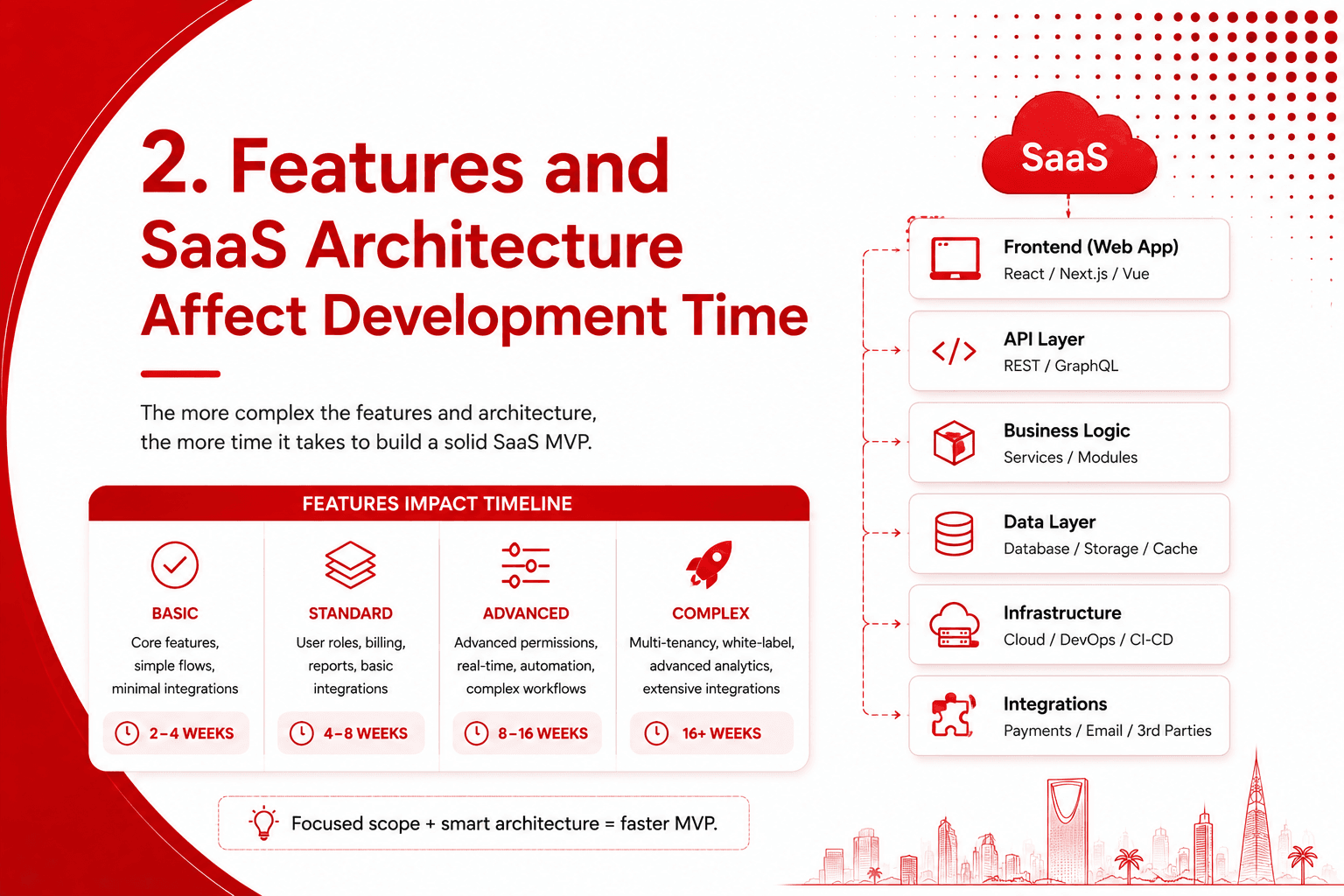
Two products can each have 20 screens but require completely different timelines.
A basic workflow application for one customer is different from a multi-tenant SaaS platform that must safely support hundreds of organizations, subscription plans, integrations, and multiple levels of access.
Multi-tenant architecture
Multi-tenancy allows multiple customers or organizations to use the same product while keeping their data, users, and configurations separated.
The platform must determine:
- Which tenant a user belongs to
- Which data that user can access
- Which actions the user can perform
- Which subscription is active
- Which features are included in that subscription
- How usage limits are enforced
- What happens when a subscription expires
- How an organization and its data are deleted
The AWS SaaS Lens provides architecture guidance specifically for designing and operating multi-tenant SaaS workloads. Tenant identity, isolation, onboarding, billing, monitoring, and operational visibility must be considered as connected parts of the product.
Multi-tenancy may add time during the initial build, but retrofitting tenant isolation after customers are already using the platform is considerably more difficult.
Authentication and user permissions
A basic MVP might have two roles: administrator and user. A complex B2B platform might need:
- Account owner
- Organization administrator
- Department manager
- Employee
- Client
- Vendor
- Auditor
- Support agent
- Platform administrator
Every role requires permission rules, UI states, backend authorization, and tests.
Adding enterprise features such as SSO, SCIM provisioning, domain-based access, advanced audit logs, or custom roles can add several weeks to the schedule.
Subscription billing
Subscription billing involves more than adding a checkout page.
The development team may need to support:
- Monthly and annual subscriptions
- Free trials
- Multiple pricing tiers
- Per-seat pricing
- Usage-based billing
- Plan upgrades
- Plan downgrades
- Proration
- Coupons
- Failed payments
- Automatic retries
- Subscription cancellation
- Refunds
- Tax handling
- Customer billing portals
- Feature entitlements
Subscription events often happen asynchronously. Stripe’s official documentation explains that subscription activity is managed through webhook events, including payment failures and status changes.
A simple fixed monthly plan may take one or two weeks to implement and test. Metered billing, seat-based subscriptions, complex entitlements, and multiple billing scenarios can take significantly longer.
Third-party integrations
Every integration adds uncertainty because part of the feature depends on an external provider.
Common integrations include:
- Stripe
- Salesforce
- HubSpot
- QuickBooks
- Xero
- Microsoft 365
- Google Workspace
- Twilio
- Slack
- DocuSign
- OpenAI or other AI providers
- Industry-specific data services
- Legacy enterprise systems
A well-documented API with a maintained sandbox can be integrated relatively quickly. A legacy API with incomplete documentation, inconsistent data, or manual approval processes may add several weeks.
Integration estimates should include:
- Authentication
- Data mapping
- Synchronization logic
- Webhook processing
- Rate limits
- Error handling
- Retry policies
- Duplicate prevention
- Logging
- Testing
- Monitoring
- Provider approval when required
Dashboards and reporting
A basic dashboard with a few stored metrics is relatively straightforward. Complexity increases when the product requires:
- Real-time data
- Custom reports
- Large datasets
- Complex filters
- Multiple user-specific views
- Scheduled reports
- CSV, Excel, or PDF exports
- Historical comparisons
- Data warehouses
- Business intelligence integrations
The user interface may look simple, but accurate reporting often requires substantial backend and data-modeling work.
AI functionality
A basic integration with an AI API can be completed quickly. A dependable AI product feature usually requires more.
The scope may include:
- Prompt and workflow design
- Retrieval-augmented generation
- Data preparation
- Evaluation datasets
- Output validation
- Guardrails
- Usage limits
- Cost controls
- Failure handling
- Human review
- Privacy requirements
- Monitoring for quality changes
If AI is not the core value proposition, it may be better to launch the first MVP without it and add the feature after validating the main workflow.
Approximate feature impact
The following ranges are planning estimates, not guarantees. Workstreams can overlap, and the same feature may take more or less time depending on requirements.
| Feature | Possible timeline impact |
|---|---|
| Basic authentication | 3–7 days |
| Multiple roles and permissions | 1–3 weeks |
| Multi-tenant organizations | 2–4 weeks |
| Basic subscription billing | 1–2 weeks |
| Complex or usage-based billing | 2–5 weeks |
| One well-documented integration | 1–3 weeks |
| Complex or legacy integration | 3–6+ weeks |
| Basic reporting | 1–2 weeks |
| Advanced real-time reporting | 3–6+ weeks |
| Simple AI integration | 1–3 weeks |
| Production-grade AI workflow | 4–8+ weeks |
| Native mobile application | 6–16+ weeks |
These estimates are not automatically added together. Product design, backend development, frontend development, integrations, and testing can run in parallel when the team is structured correctly.
That team structure—and the speed of product decisions—determines how much parallel work is actually possible.
3. Team Structure and Decision Speed Influence Delivery
Adding more developers does not always reduce the SaaS MVP development timeline. A larger team creates more communication, review, and coordination work.
The goal is to assemble the smallest cross-functional team capable of delivering the product safely.
Typical SaaS MVP team
A professional MVP team may include:
- Product strategist or business analyst
- Product owner
- UX/UI designer
- Software architect or technical lead
- Frontend developer
- Backend developer
- QA engineer
- DevOps engineer
- Project manager
Some experienced team members can cover multiple responsibilities. For example, a technical lead may also contribute backend development, while a product designer may handle user research and interface design.
The important question is not how many people are assigned. It is whether all necessary responsibilities are covered.
Common team configurations
Founder and one full-stack developer
This setup can work for a technically simple prototype or internal beta.
The main risks are:
- No independent testing
- Limited design capacity
- Architecture decisions concentrated in one person
- Slow progress when the developer is blocked
- Limited DevOps and security expertise
Small cross-functional product team
A designer, technical lead, two developers, and QA support can often deliver a focused SaaS MVP in 8–16 weeks.
This structure allows design, backend, frontend, testing, and infrastructure work to overlap.
Large development team
A larger team can help when the product has several independent modules. However, it does not automatically accelerate a tightly connected MVP.
Nine developers cannot efficiently build a product in one month if requirements, architecture, and decisions are still unclear.
The founder’s availability affects the timeline
Many SaaS projects are delayed by product decisions rather than programming.
The development team may need answers about:
- Which user role can approve an action
- What happens when a payment fails
- Which report is required for launch
- Whether a feature belongs in the MVP
- How existing customer data should be migrated
- Which billing model should be used
- Which design variation should be approved
- What should happen in an edge case
If these questions remain unanswered for days, development either stops or continues based on assumptions that may later require rework.
Assign one product owner who can:
- Make scope decisions
- Approve designs
- Answer domain questions
- Review each product increment
- Coordinate internal stakeholders
- Protect the MVP from unplanned additions
A realistic 12-week SaaS MVP roadmap
The exact plan will vary, but a focused project may follow this structure:
| Week | Primary activities |
|---|---|
| 1 | Discovery, user flows, requirements and success metrics |
| 2 | Wireframes, architecture and backlog approval |
| 3 | UI design, infrastructure and authentication |
| 4 | Core backend and frontend workflow |
| 5 | Core workflow development |
| 6 | Organizations, users and permissions |
| 7 | Dashboard and admin tools |
| 8 | Subscription billing and notifications |
| 9 | Integrations, analytics and edge cases |
| 10 | Full QA, security review and performance fixes |
| 11 | Customer beta, onboarding and final improvements |
| 12 | Production launch, monitoring and support |
These activities overlap. Design can stay ahead of development, QA can begin before all features are complete, and infrastructure can be prepared while the core workflow is being built.
Neutrons provides SaaS MVP development from discovery and architecture through billing, integrations, cloud deployment, and post-launch support.
Once the team has completed the product’s primary workflow, sufficient time must still be reserved for security, testing, and launch readiness.
4. Testing, Security, and Compliance Cannot Be Left Until the End
One of the fastest ways to miss a launch date is to treat quality assurance as a final task.
Testing should begin as soon as the first functional increment is available. Bugs discovered early are generally easier to diagnose than issues found after several connected features have been completed.
Functional testing
The team should test:
- Primary user journeys
- Forms and validation
- Roles and permissions
- Error states
- Empty states
- Notifications
- Subscription changes
- Payment failures
- Data exports
- Account deletion
- Mobile and desktop layouts
- Supported browsers
Each supported combination of role, subscription, status, and integration creates more test scenarios.
Automated testing
Automated tests can include:
- Unit tests
- Integration tests
- API tests
- Permission tests
- Billing event tests
- End-to-end tests
- Regression tests
Automated testing adds development time during the build, but it reduces the risk that later changes silently break existing functionality.
Security
A production SaaS MVP should consider:
- Secure authentication
- Password and session management
- Tenant isolation
- Backend authorization
- Encryption in transit
- Protection of sensitive data
- Rate limiting
- Secure API design
- Audit logging
- Dependency management
- Secret management
- Backup and recovery
- Error monitoring
- Incident response
The OWASP Application Security Verification Standard provides testable requirements for web application security controls. The NIST Secure Software Development Framework also provides practices that can be integrated into the software development lifecycle.
Security requirements should be prioritized according to the product’s data, users, industry, and risk—not added as an undefined checklist immediately before launch.
Compliance requirements
A SaaS platform handling healthcare, financial, educational, government, or other sensitive information may need additional controls and documentation.
Depending on the product, requirements could affect:
- Architecture
- Data storage
- Access controls
- Audit trails
- Vendor selection
- Logging
- Retention policies
- Disaster recovery
- Documentation
- Security assessments
- Contractual obligations
Founders should identify regulatory or customer security expectations during discovery. Discovering them in the final week can delay launch by months.
Infrastructure and launch preparation
Before customers use the product, the team may need to complete:
- Production cloud configuration
- Domain and DNS setup
- TLS certificates
- CI/CD pipelines
- Database migrations
- Automated backups
- Recovery testing
- Error tracking
- Performance monitoring
- Usage analytics
- Email authentication
- Support workflows
- Status and incident processes
- Customer data import
- Admin documentation
A product is not launch-ready simply because the main screens work on a developer’s computer.
Beta launch
A controlled beta allows the team to test the product with a small group of real customers.
A useful beta should have:
- A defined start and end date
- A limited customer group
- Clear success metrics
- A feedback process
- Error and usage monitoring
- A support channel
- Criteria for public launch
The beta may uncover workflow problems that internal testing cannot reproduce. These discoveries are valuable, but the schedule should include time to respond to them.
With launch requirements understood, the final challenge is reducing time to market without sacrificing the foundations needed for growth.
5. How to Build and Launch a SaaS MVP Faster
A fast SaaS launch is usually the result of disciplined scope and quick decisions—not skipped testing or rushed code.
Start with discovery
A short discovery phase can prevent weeks of rework.
Discovery should establish:
- Target customer
- Business problem
- Core user journey
- Revenue model
- User roles
- Required integrations
- Data requirements
- Security expectations
- Launch metrics
- MVP exclusions
A product team can build faster when it is not repeatedly debating the purpose of each feature.
Choose one customer segment
Building for startups, enterprises, agencies, and individual users simultaneously creates conflicting requirements.
Enterprise customers may need SSO, audit logs, procurement reviews, custom contracts, and granular permissions. Small businesses may prioritize easy onboarding and simple pricing.
Choose one initial segment and optimize the MVP around it.
Limit roles and pricing plans
Each additional role creates new permission and testing scenarios. Each additional pricing plan creates more billing and entitlement logic.
A first version may only need:
- Owner
- Team member
- Platform administrator
It may also need only one paid plan or a simple monthly and annual version of the same plan.
Buy commodity capabilities
Do not build every technical component from scratch.
Established services can handle:
- Authentication
- Payments
- Email delivery
- File storage
- Error monitoring
- Analytics
- Customer support
- Video processing
- Electronic signatures
Custom development should focus on the workflow that differentiates the product.
Avoid premature enterprise features
Before the first launch, many products do not need:
- Microservices
- Multi-region infrastructure
- Complex custom roles
- Advanced data warehousing
- Native applications for two platforms
- White-labeling
- Dozens of integrations
- Custom report builders
- Multiple product editions
- Full internationalization
Design the architecture so that the product can grow, but do not build every future capability before customer demand exists.
Set a scope freeze
Once development begins, new ideas should enter a post-MVP backlog unless they are required to make the primary user journey work.
A scope freeze does not prevent learning. It prevents every new insight from delaying the release.
Use weekly product demonstrations
At the end of each week or sprint, review working software.
Confirm:
- Does the flow match the approved requirements?
- Are permissions working correctly?
- Are there unanswered product decisions?
- Is anything unnecessary for launch?
- Has a new technical risk appeared?
- Does the current progress support the target date?
Frequent demonstrations make problems visible while they are still manageable.
Prepare launch work early
Pricing pages, terms, privacy documentation, onboarding emails, support processes, beta recruitment, and analytics should not wait until development is complete.
Running product, legal, marketing, and customer-success work in parallel can shorten the total path to market.
When is a 6-week SaaS MVP possible?
A 6-week timeline may be realistic when:
- The target customer is clearly defined
- The core workflow is simple
- Requirements are already validated
- The product is web-only
- There are few user roles
- Billing is straightforward
- External integrations are limited
- A dedicated team is available
- Stakeholders provide same-day decisions
- Compliance requirements are limited
- Existing components can be reused
When is a 6-week timeline unrealistic?
It is likely unrealistic when the product includes:
- Several independent modules
- Native iOS and Android apps
- Complex multi-tenant permissions
- Usage-based billing
- Legacy integrations
- Large data migrations
- Real-time collaboration
- Advanced AI workflows
- Healthcare or financial data
- Enterprise procurement requirements
- Multiple countries and currencies
- Extensive reporting
- Offline functionality
In these cases, a phased launch is safer. The team can release one customer workflow first, followed by additional modules in planned increments.
How Long Does Neutrons Take to Build a SaaS MVP?
A focused SaaS MVP developed by Neutrons typically takes 6–12 weeks from kickoff to controlled launch. A broader production-ready B2B product may take 10–16 weeks or longer, depending on the feature set, integrations, data, and security requirements.
The process is divided into four stages:
- Discovery and scoping: clarify the business model, users, core workflow, and launch requirements.
- UX and architecture: design the experience and plan multi-tenancy, billing, integrations, and infrastructure.
- Build and integrate: deliver functional product increments with regular demonstrations.
- Launch and scale: deploy, monitor, collect customer feedback, and plan the next release.
The objective is not to fit every project into an artificial deadline. It is to identify the smallest product that can deliver real customer value and launch it without creating an immediate need for a rebuild.
Review the Syncentra SaaS platform case study for an example of an end-to-end SaaS product designed and developed by Neutrons.
Conclusion
So, how long does it take to build a SaaS MVP? For most focused products, a realistic timeline is 8–16 weeks.
A simple MVP may launch within 6–12 weeks. A product with complex integrations, advanced billing, enterprise permissions, mobile applications, or regulatory requirements may require 4–8 months or more.
The five factors that have the greatest impact are:
- The clarity and size of the MVP scope
- Multi-tenancy, billing, roles, and integrations
- The experience and structure of the development team
- Testing, security, compliance, and launch requirements
- Decision speed and control of new feature requests
The fastest path is not to remove essential engineering work. It is to build fewer features, make decisions quickly, reuse reliable infrastructure, and test with customers as early as possible.
If you want a realistic timeline for your product, contact Neutrons for a no-obligation SaaS MVP assessment based on your target users, core workflow, integrations, and launch goals.
Frequently Asked Questions About SaaS MVP Timelines
1. How long does it take to build a SaaS MVP?
A focused SaaS MVP generally takes 8–16 weeks. A highly focused product with one workflow and limited integrations may launch in 6–12 weeks. More complex platforms can require 4–8 months or longer.
2. Can a SaaS MVP be built in one month?
A prototype or technical proof of concept may be built in one month. A production-ready SaaS MVP is only realistic in that period when the scope is extremely limited, requirements are complete, and reusable components cover most supporting functionality.
3. What is included in a SaaS MVP?
A SaaS MVP usually includes authentication, a core customer workflow, basic roles, a dashboard, an admin area, billing, notifications, monitoring, backups, and a production environment. The exact scope should be based on what the product needs to validate.
4. How long does SaaS discovery take?
A focused discovery phase often takes one to three weeks. Complex enterprise products may require longer because of stakeholder interviews, legacy systems, data requirements, compliance, and integration analysis.
5. How long does SaaS UX design take?
A focused MVP may require two to four weeks of UX and UI design. Design can overlap with architecture and development when the team approves the primary user flows first.
6. Does multi-tenant architecture increase development time?
Yes. The team must implement tenant identity, data isolation, user roles, subscription entitlements, and tenant-aware operations. Planning multi-tenancy from the beginning is usually safer than adding it after launch.
7. How much time does subscription billing add?
A basic subscription integration may add one or two weeks. Trials, multiple plans, seat-based pricing, metered billing, proration, taxes, and complex entitlements may require several additional weeks.
8. Do third-party integrations delay an MVP?
They can. The timeline depends on API quality, documentation, sandbox access, data complexity, provider approval, and error-handling requirements. A complex legacy integration can become one of the longest project workstreams.
9. Should a SaaS MVP include a mobile app?
Only when mobile-specific functionality is essential to the core value. A responsive web application is often faster for initial validation. Native mobile apps can be added after customer demand is confirmed.
10. Can AI accelerate SaaS MVP development?
AI-assisted development can speed up some coding, documentation, and testing tasks, but it does not eliminate product discovery, architecture, security, integration, review, or user validation. AI product features may also add evaluation, privacy, and monitoring requirements.
11. What commonly delays SaaS development?
Common delays include an unclear scope, slow stakeholder decisions, adding features during development, complex integrations, incomplete data, underestimated billing logic, late security requirements, and limited access to test users.
12. How can founders shorten the MVP timeline?
Define one target customer, prioritize one core workflow, use proven services for commodity features, assign a decisive product owner, review working software weekly, and move nonessential features to a post-launch roadmap.