Blog
Next.js vs Laravel for SaaS Development: Which Should You Choose?
Choosing the wrong technology stack rarely causes a SaaS product to fail immediately. The consequences usually appear later: slower releases, rising development costs, difficult integrations, performance bottlenecks, or an architecture that becomes harder to maintain as the customer base grows.
That is why the Next.js vs Laravel for SaaS development decision should not be reduced to which framework is faster or more popular.
Next.js and Laravel can both power successful SaaS products, but they approach development from different directions. Next.js is a React framework built around modern web experiences and full-stack JavaScript or TypeScript development. Laravel is a PHP application framework with a mature ecosystem for backend logic, authentication, databases, queues, notifications, APIs, and subscription billing.
Some SaaS products should use Next.js. Others are better suited to Laravel. For more complex platforms, using a Next.js frontend with a Laravel backend can provide the strongest balance.
This guide compares the two options across product experience, backend capabilities, scalability, cost, development speed, and team fit so startup founders, CTOs, and product leaders can make an informed decision.
1. Understand What You Are Actually Comparing

Before comparing features, it is important to understand that Next.js and Laravel are not identical types of frameworks.
What is Next.js?
Next.js is a React framework for building modern web applications. It allows development teams to create public websites, customer dashboards, internal application screens, APIs, and server-side functions using JavaScript or TypeScript.
The modern Next.js App Router supports Server Components, Client Components, layouts, streaming, data fetching, and different rendering strategies. Developers can also use Route Handlers to create HTTP endpoints inside a Next.js application.
For SaaS development, this makes Next.js especially attractive when the product depends on:
- A fast and highly interactive user interface
- Public landing pages that need search visibility
- A consistent JavaScript or TypeScript stack
- Real-time dashboards and product analytics
- Rapid frontend experimentation
- Responsive experiences across desktop and mobile browsers
Next.js can be used as a full-stack framework, especially for an MVP or a moderately complex SaaS product. However, authentication, billing, background processing, database access, and other backend capabilities are often assembled through external services or additional libraries.
What is Laravel?
Laravel is a PHP application framework designed to handle complete web application backends and business workflows.
Its ecosystem includes routing, validation, database management, authentication, authorization, notifications, scheduled tasks, queues, caching, API development, and testing tools. Laravel can render its own frontend with Blade or Livewire, use React or Vue through Inertia, or operate as an independent API backend.
Laravel’s official starter kits include foundations for registration, login, password resets, email verification, two-factor authentication, rate limiting, and team-based applications. These built-in capabilities can reduce the amount of foundational work required for many SaaS products.
Laravel is particularly suitable when a platform contains:
- Complex business rules
- Multiple user roles and permissions
- Detailed administrative workflows
- Large numbers of database operations
- Background jobs and scheduled processes
- Subscription, invoice, or payment logic
- APIs consumed by multiple applications
- Enterprise integrations
This initial distinction leads to the real question: does your product need a frontend-first framework, a backend-centered application framework, or both?
2. Compare the Capabilities Every SaaS Platform Needs
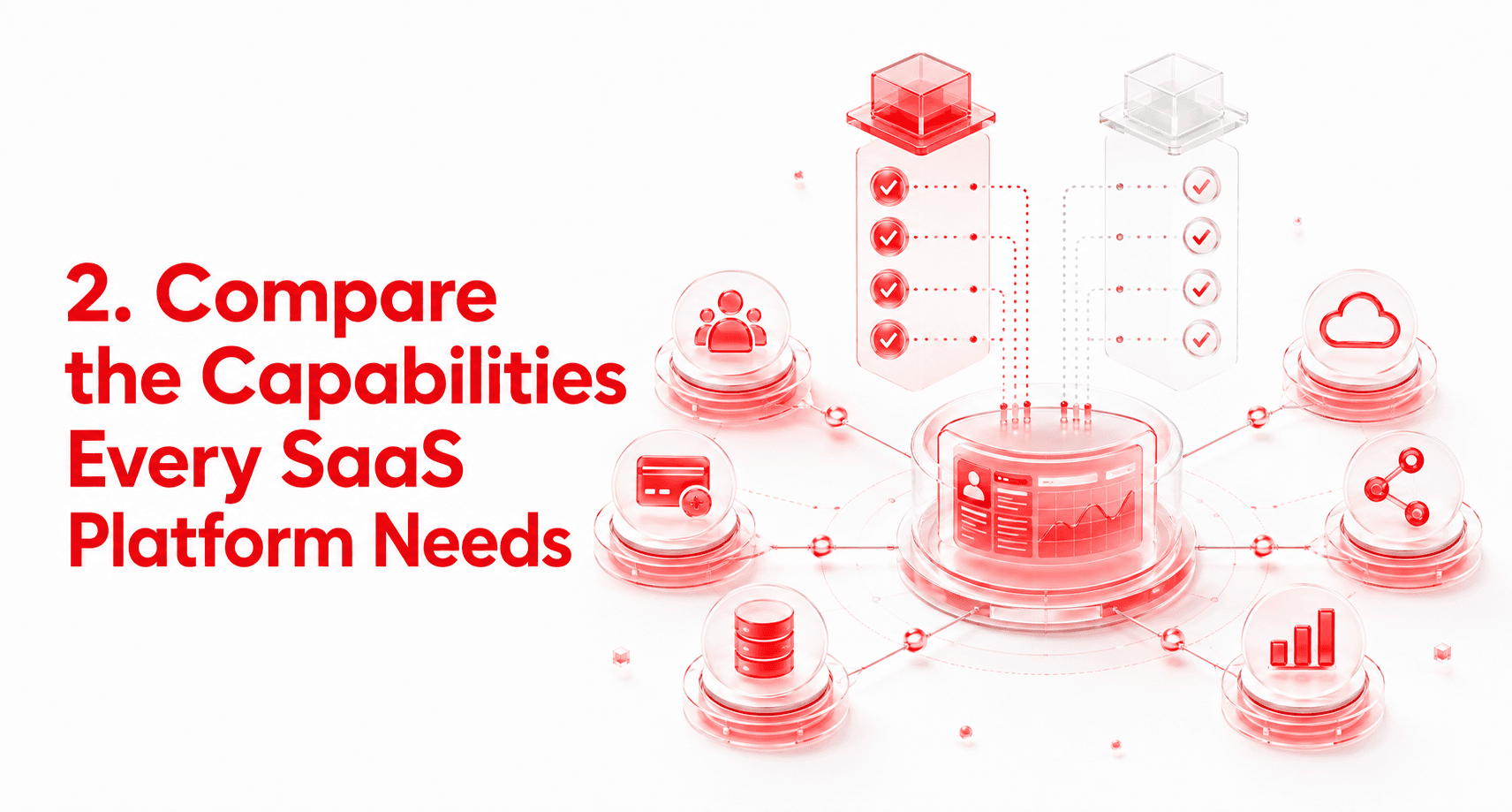
A SaaS platform is more than a dashboard connected to a database. It usually requires user management, tenant isolation, subscriptions, integrations, notifications, security, analytics, and reliable background processing.
Here is how Next.js and Laravel compare across those requirements.
| SaaS requirement | Next.js | Laravel |
|---|---|---|
| Primary strength | Modern React product experiences | Backend workflows and business logic |
| Main language | JavaScript or TypeScript | PHP, with optional JavaScript frontend |
| Frontend development | React, Server Components and Client Components | Blade, Livewire, React, Vue or Svelte |
| API development | Route Handlers and Server Functions | Controllers, API resources and middleware |
| Authentication | Usually implemented with a library or external provider | Starter kits, Fortify, Sanctum or external providers |
| Database layer | Requires an ORM or database service | Eloquent ORM and migrations included |
| Subscription billing | Usually Stripe SDK or another billing integration | Laravel Cashier for Stripe or Paddle |
| Background jobs | Requires a queue provider or separate infrastructure | Built-in queue API with multiple backends |
| SEO and public pages | Excellent rendering options for content and landing pages | Possible through server rendering, Blade or Inertia SSR |
| Deployment | Node.js, Docker, static export or supported cloud platforms | VPS, containers, managed cloud or serverless infrastructure |
| Best team fit | React and TypeScript teams | PHP and backend-oriented teams |
Authentication and user management
Authentication is a critical SaaS requirement. It may include account registration, password resets, social login, multi-factor authentication, enterprise SSO, user invitations, role-based access, and session management.
Next.js provides the application patterns required to implement authentication, but teams typically select an authentication library or a managed identity provider. The official Next.js authentication guide also separates authentication, session management, and authorization as different responsibilities.
Laravel provides more of this foundation inside its ecosystem. Laravel Fortify and the official starter kits cover common authentication flows, while Laravel Sanctum supports first-party SPAs and token-based APIs. Laravel’s documentation even identifies a separately deployed Next.js application as a possible frontend for a Laravel-powered API.
The right option depends on whether you want a managed authentication service, a customizable application-owned system, or enterprise identity integration.
Subscription billing
Both frameworks can integrate with Stripe and other payment providers.
With Next.js, developers commonly integrate directly with a payment provider’s SDK, hosted checkout, billing portal, and webhooks. This offers flexibility, but the team must design how plans, trials, subscription states, metered usage, failed payments, and permissions interact with the application.
Laravel offers Laravel Cashier, which handles much of the recurring billing foundation for Stripe. It supports subscriptions, different prices, quantities, trials, payment methods, billing portals, and webhook-driven subscription updates.
Cashier can accelerate standard subscription models. However, highly customized billing rules still require careful product and data architecture regardless of the framework.
Background jobs and automation
SaaS products frequently process work that should not delay a customer request, including:
- Sending transactional emails
- Generating reports
- Importing spreadsheets
- Processing uploaded files
- Synchronizing third-party data
- Running AI workflows
- Delivering webhooks
- Calculating usage
- Creating invoices
Laravel includes a unified queue system that works with Redis, Amazon SQS, relational databases, and other queue backends. It also provides patterns for retries, failed jobs, priorities, batches, and queue monitoring.
A Next.js application can initiate background tasks, but long-running or reliable processing generally requires dedicated infrastructure such as a queue service, worker environment, workflow platform, or separate backend service.
This difference becomes increasingly important as an MVP evolves into a production SaaS platform.
3. Evaluate Development Speed, Cost, and Team Fit

Framework selection affects more than technical architecture. It also influences your hiring options, delivery timeline, operational expenses, and long-term maintenance costs.
Which framework is faster for an MVP?
Next.js can be extremely fast for teams that already know React and TypeScript. A single team can build the marketing website, application interface, API endpoints, and selected server-side functionality in one ecosystem.
It is often a strong choice for:
- Design-led SaaS products
- Customer portals
- Analytics dashboards
- AI application interfaces
- Collaboration tools
- Marketplace frontends
- Products using managed backend services
Laravel can deliver an MVP quickly when the product contains significant backend logic. Its conventions and built-in ecosystem reduce the number of architectural decisions required for authentication, database workflows, queues, notifications, and recurring billing.
It is often efficient for:
- Workflow automation platforms
- Operational management systems
- B2B SaaS products
- Industry-specific platforms
- Booking and scheduling systems
- Financial or reporting applications
- Products with complex administrative portals
A focused MVP commonly takes weeks rather than days, regardless of the framework. Scope quality has a greater effect on delivery time than framework selection. Our guide to how long it takes to build a SaaS MVP explains the factors that influence a realistic timeline.
How does the framework affect development cost?
Neither Next.js nor Laravel is automatically the cheaper choice.
Your total development cost will depend on:
- Feature scope
- UX complexity
- Multi-tenant architecture
- Number of user roles
- Billing model
- Third-party integrations
- Security requirements
- Reporting and analytics
- Infrastructure
- Quality assurance
- Post-launch support
Next.js may reduce initial coordination costs when one TypeScript team can own the frontend and server-side application. However, adding several external services for authentication, queues, workflows, storage, and billing can increase integration and operating costs.
Laravel may reduce backend implementation time by providing more capabilities inside one ecosystem. On the other hand, a separate React or Next.js frontend can require additional frontend development and API coordination.
For a broader budget breakdown, read How Much Does It Cost to Build a SaaS Platform?.
Which developers are easier to hire?
The answer depends on your location, hiring model, and existing team.
Choose Next.js when your developers are already experienced with React, TypeScript, Node.js, frontend performance, and the modern JavaScript ecosystem.
Choose Laravel when your team is strong in PHP, relational database design, API development, backend architecture, queues, and server operations.
If your team already has a proven technology stack, changing frameworks without a compelling product reason can create unnecessary risk. Familiarity improves code quality, estimation accuracy, testing, and delivery speed.
The best framework on paper is not always the best framework for the team responsible for maintaining it.
4. Choose Between a Next.js, Laravel, or Hybrid Architecture
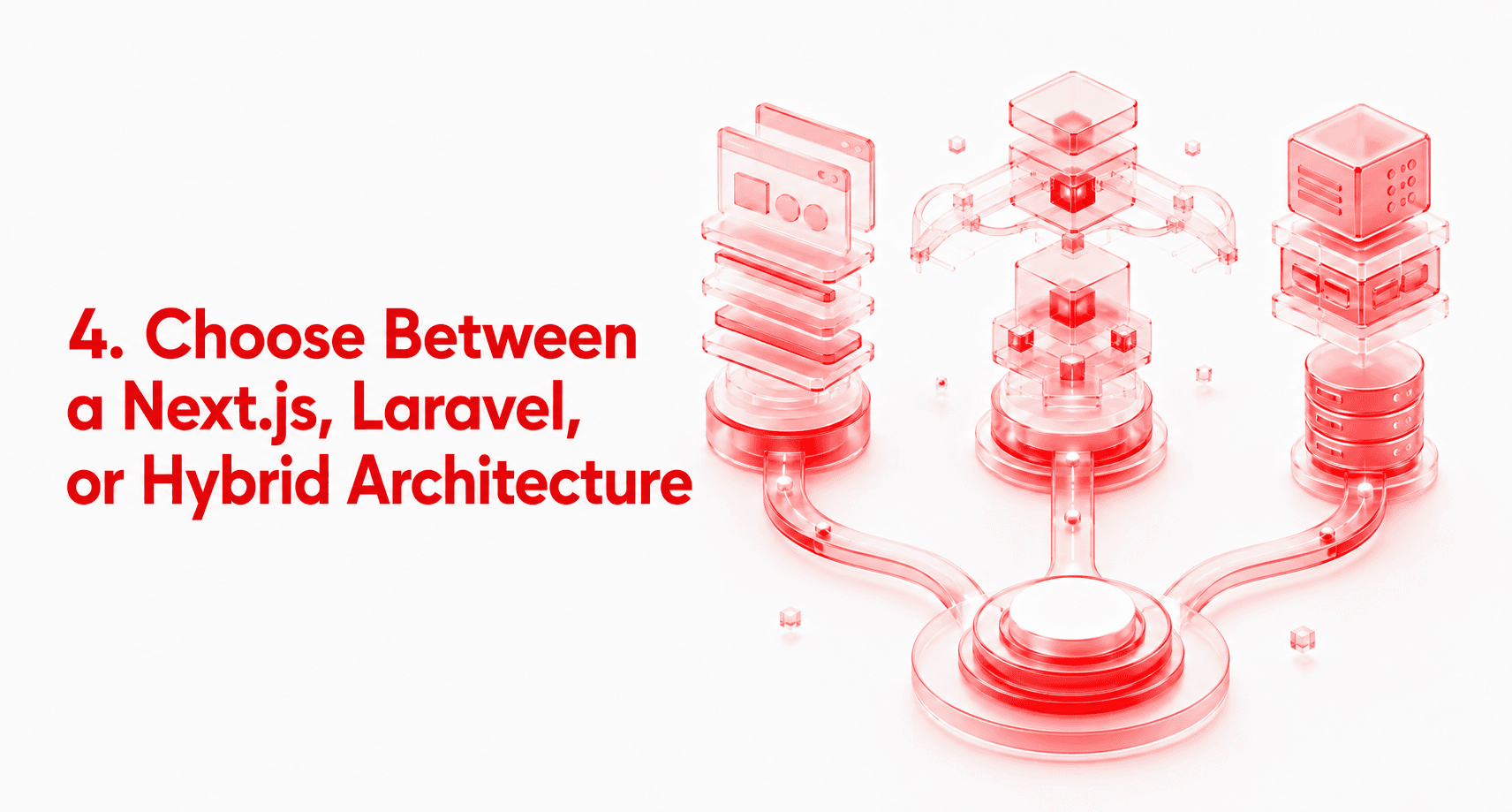
After comparing the core capabilities and business impact, most SaaS projects arrive at one of three practical architectures.
Option A: Build the SaaS primarily with Next.js
A Next.js-centered architecture can include:
- Next.js for the public website and product interface
- Server Components and Server Functions
- Route Handlers for application endpoints
- PostgreSQL or another database
- A TypeScript ORM
- Managed authentication
- Stripe for subscription billing
- Cloud storage
- A separate queue or workflow provider
This approach is a strong fit when user experience, frontend speed, public content, and rapid product iteration are central to the business.
It can also work well for early-stage products that use managed infrastructure to keep the internal engineering team small.
However, founders should confirm how the architecture will handle long-running tasks, webhook reliability, tenant isolation, database transactions, scheduled work, and audit logs before development starts.
Option B: Build the SaaS primarily with Laravel
A Laravel-centered application may use:
- Laravel for routing and backend logic
- Eloquent for database operations
- Blade, Livewire or Inertia for the frontend
- Laravel Fortify or Sanctum for authentication
- Laravel Cashier for subscription billing
- Laravel queues for asynchronous jobs
- Redis for caching and queue processing
- Scheduled commands for recurring operations
This architecture keeps many SaaS capabilities within a consistent ecosystem. It is especially effective for backend-heavy products where business workflows are more important than advanced public-facing frontend experiences.
Laravel does not force a traditional or outdated interface. Its current starter kits support React, Vue, Svelte, and Livewire, while Inertia can provide a modern single-page application experience without requiring a completely separate API.
Option C: Use Next.js with a Laravel backend
A hybrid architecture uses Next.js for the user-facing product and Laravel as a dedicated API and business-logic backend.
This combination is often the best choice when a SaaS product needs both:
- A sophisticated React interface
- SEO-friendly public pages
- Independent frontend releases
- Complex backend rules
- Reliable background workers
- Mobile or third-party API access
- Multiple integrations
- A backend that can serve several clients
Laravel Sanctum can authenticate a separate first-party SPA, including a Next.js frontend. The Laravel API can manage tenants, permissions, subscriptions, workflows, and database transactions while Next.js handles the product experience.
The tradeoff is additional complexity. A hybrid system requires clear API contracts, cross-origin and session configuration, coordinated deployments, shared error monitoring, and disciplined version management.
Do not choose a hybrid architecture simply because it appears more powerful. Choose it when the separation solves a real product, team, or scaling requirement.
5. Make the Final Decision with a SaaS Architecture Checklist
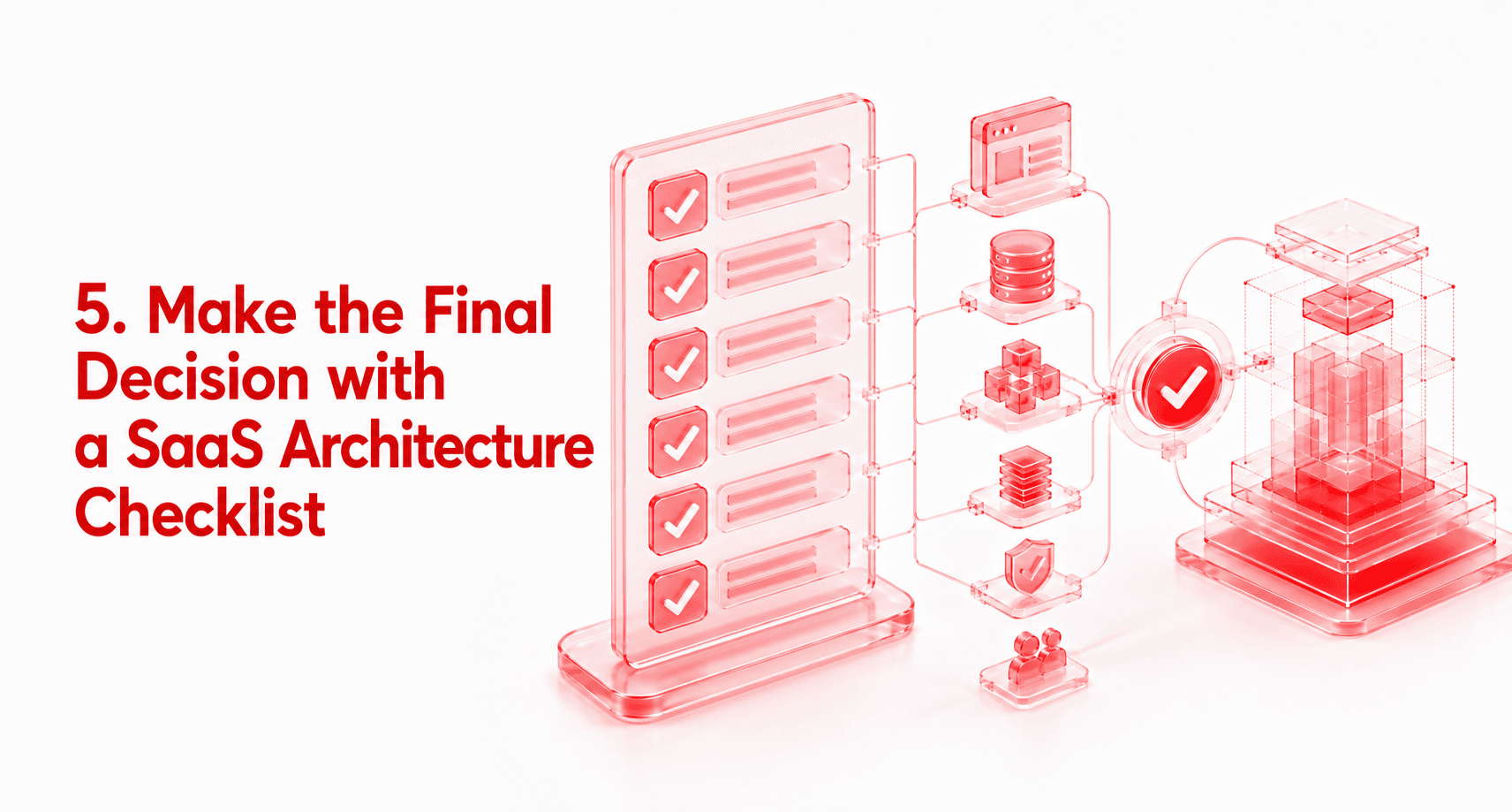
The final Next.js vs Laravel for SaaS development decision should be based on the product you intend to operate over the next several years—not only the fastest way to display the first dashboard.
Use the following checklist during technical discovery.
Choose Next.js when:
- Your product is frontend-heavy and highly interactive.
- React is already the core skill of your development team.
- SEO and public landing-page performance are important.
- You want JavaScript or TypeScript across most of the stack.
- Your backend requirements are moderate or handled by managed services.
- You expect frequent UI experiments and product-led growth.
- You are comfortable selecting and maintaining several supporting services.
Choose Laravel when:
- The product contains complex backend workflows.
- Database integrity and transactional operations are central.
- You need queues, scheduled tasks, notifications, and automation.
- Subscription billing follows standard recurring payment patterns.
- You want an application-owned authentication system.
- Your team has strong PHP and Laravel experience.
- You prefer a structured, integrated backend ecosystem.
Consider Next.js with Laravel when:
- The platform needs a premium React product experience and a substantial backend.
- The backend must serve web, mobile, and third-party clients.
- Frontend and backend teams need independent release cycles.
- Complex integrations or background processes are essential.
- The business expects significant product expansion.
- The additional operational complexity is justified.
Questions to answer before approving the stack
- What is the product’s most important customer workflow?
- Does the application require true multi-tenancy?
- How complex are roles, permissions, and enterprise accounts?
- Will the platform include usage-based or seat-based billing?
- Which operations must run asynchronously?
- Are public SEO pages part of the acquisition strategy?
- Will mobile apps or partners consume the same API?
- Which framework does the long-term development team understand best?
- How will the system be monitored, backed up, and recovered?
- Can the architecture support the next two product stages without a major rewrite?
Next.js can be deployed as a Node.js server, Docker container, static export, or through compatible cloud platforms, according to its official deployment documentation. Laravel also supports multiple infrastructure approaches, but the deployment model should be selected according to workers, queues, database requirements, traffic patterns, and compliance needs.
Framework choice is only one part of SaaS architecture. Tenant isolation, authorization, billing state, observability, deployment automation, backups, and testing will have a larger long-term effect than the framework’s name.
Final Verdict: Is Next.js or Laravel Better for SaaS?
There is no universal winner.
Next.js is usually the stronger choice for frontend-led SaaS products that require a modern React experience, fast public pages, and a unified TypeScript development workflow.
Laravel is usually the stronger choice for backend-intensive SaaS platforms that rely on complex workflows, relational data, background jobs, application-owned authentication, and integrated subscription management.
For products that need both capabilities at a high level, a Next.js frontend connected to a Laravel backend can provide a scalable solution—provided the added architectural complexity is justified.
The most reliable decision comes from mapping the framework to the product requirements, development team, budget, and growth roadmap.
Neutrons designs and develops custom SaaS platforms using technologies including Next.js, Laravel, PostgreSQL, Supabase, Strapi, and Stripe. We select the architecture around the business model instead of forcing every product into the same stack.
If you are evaluating the right technology for a new SaaS product, contact Neutrons to discuss your requirements and receive a clear technical roadmap.
Frequently Asked Questions
Is Next.js good for SaaS development?
Yes. Next.js is well suited to SaaS products that need a modern React interface, server rendering, public SEO pages, dashboards, and a TypeScript-based development workflow. More complex backend operations may require supporting services or a dedicated backend.
Is Laravel good for SaaS development?
Yes. Laravel is particularly strong for SaaS products with complex business logic, relational data, authentication, queues, scheduled processes, notifications, APIs, and recurring subscription billing.
Can Next.js replace Laravel?
For some SaaS products, yes. Next.js can handle frontend and server-side application functionality within one codebase. However, products with extensive backend workflows, long-running processes, or complex integrations may benefit from Laravel or another dedicated backend.
Can Next.js and Laravel be used together?
Yes. Next.js can serve as the frontend while Laravel provides the API, authentication, database logic, queues, and integrations. This is a strong architecture for complex products but requires more deployment and API coordination.
Which is faster: Next.js or Laravel?
Neither framework is always faster. Next.js offers strong rendering and caching options for frontend experiences, while Laravel can efficiently process backend workflows. Database design, caching, infrastructure, code quality, and workload shape matter more than framework choice alone.
Which is better for a SaaS MVP?
Next.js is often better for a frontend-led MVP built by a React or TypeScript team. Laravel can be faster for backend-heavy products because many common application capabilities are available inside its ecosystem.
Is Next.js better for SaaS SEO?
Next.js provides strong rendering, metadata, caching, and static-generation options for public pages. This makes it effective for SaaS products that depend on organic acquisition. Technical SEO still depends on implementation quality, content, site structure, and performance.
Which framework is more scalable?
Both frameworks can scale when designed and deployed correctly. Scalability depends on database architecture, tenant isolation, caching, queue design, infrastructure, observability, and engineering practices—not only on whether the application uses Next.js or Laravel.